Moonshot's Red Queen
Kimi K3 represents a new frontier in open-source, open-weight models. But the focus on unit economics is misguided. It has bigger implications for the frontier labs and their approach to safety.


In short
Kimi K3 is a very capable model.
But the immediate reaction—that it will displace frontier models and pop the AI bubble—seems unfounded.
The more significant impact will come from its effect on frontier labs and AI regulation.
For both labs and the state, the question will be: how should we act if we expect this capability to be public in two months time?
This shift might ultimately be for the wider good. Stasis brings its own problems.
Ride the Tiger
In March of this year, details of an unannounced and highly capable model were leaked by Anthropic. Included in that leak, and confirmed by the official announcements that came in the weeks after, was that Anthropic had made the decision not to release the model right away. Its capabilities—particularly its ability to find and quickly exploit cybersecurity vulnerabilities—presented too many risks for general access. The model, Mythos Preview, would instead be shared with a small group of software providers responsible for maintaining critical digital infrastructure, who would use it for cyber hardening.
The reaction to the Mythos announcement and the eventual release of Fable 5 is already becoming hard to remember. A month ago, Andrew Curran wrote The Window Has Closed. He said what many other people were thinking at the time: Mythos represents such a significant step forward in capabilities that it might be, on its own, a source of durable advantage. He quotes the leaked Anthropic Series C deck, which says “We believe that companies that train the best 2025/26 models will be too far ahead for anyone to catch up in subsequent cycles”.

Well. That did not last as long as I expected.
Anthropic, however, was not as short-sighted as I was. The piece announcing the launch of Project Glasswing on April 7th included this certified prophecy. Emphasis mine:
Given the rate of AI progress, it will not be long before such capabilities proliferate, potentially beyond actors who are committed to deploying them safely. The fallout—for economies, public safety, and national security—could be severe. Project Glasswing is an urgent attempt to put these capabilities to work for defensive purposes.
As it turns out, not long was three months and ten days. Kimi K3 is a good model. It’s open source. And, in ten more days, it will also be open weights. Hold on to your tiger.

The Hopium and the Copium
There is much sangfroid online at the prospect of an open weights Mythos. As I have written here before, there were many people who balked at what they saw as heavy-handedness and self-importance from Anthropic. A smaller group would simply prefer AI to be ungovernable. Dean Ball, now of OpenAI, describes them as being like the Zomia peoples in James C. Scott’s excellent The Art of Not Being Governed (a reference so good that I think we should call the accelerationists, without a hint of pejorative, Hill People).
But much of this strikes me as motivated reasoning—those who have frustrations with the frontier labs, both legitimate and churlish, are pleased to see them challenged. And the more hyperbolic claims therefore seem to me to be an overreaction.
Gavin Baker of Atreides Management makes the case that Kimi K3 might be an inflection point, after which more of the gains from AI accrue to the hardware layer rather than to the big labs. More competition at the frontier reduces OpenAI and Anthropic’s pricing power, forcing them to serve tokens closer to cost price. Others on X have extended this analysis to argue that more competition at the model layer will reduce capex and potentially force a repricing of the investments that were made on the basis of high margins on tokens. Joe Weisenthal, for example, is excellent as always.


There are two problems with this argument (Baker acknowledges both in his post): first, Kimi K3 appears to be a very capable model, but it doesn’t sit at the true cost-capability frontier alongside Fable 5 and GPT-5.6-Sol. It’s slow, close to the same price as Sol, and appears to be weaker on tasks that require higher levels of logical reasoning. GPT-5.6-Sol just set a new high point on AISI’s cyber benchmark that I don’t expect Moonshot’s model to approach. There will be many tasks where Kimi K3 is not a drop-in replacement for the two current frontier models, and I suspect many of these will be among the most valuable, where the returns to intelligence are greatest.


The second is that Anthropic and OpenAI are not just thin-layer model providers. Anthropic’s breakout at the start of the year was driven by Claude Code and the combination of Opus 4.8 with its agentic coding harness. Both have internal models performing beyond the frontier of their current public models. Both have already begun diversifying into the application and implementation business. Both are taking bets on fields like cybersecurity and biotechnology, where the returns to intelligence are very high and model capabilities more defensible.
There is, of course, another element to this story. Kimi K3 was released in stealth two days before its official release. The Mythos pre-train finished in February, and Fable 5 was released in June. Testers had access to GPT-5.6 for two months before it faced a limited rollout at the request of the Trump Administration. Heavy is the head that wears the crown. Should we expect it to stay that way?


Island Megafauna
This is one consequence of the Kimi K3 launch that I think is still radically underrated.
I was talking to a friend of mine at one of the labs recently, and he said that I’ve been too bearish on AI since at least 2020. He’s probably right. I have been particularly unfair to the AI safety people. Consider this my Eliezer Yudkowsky apology form.
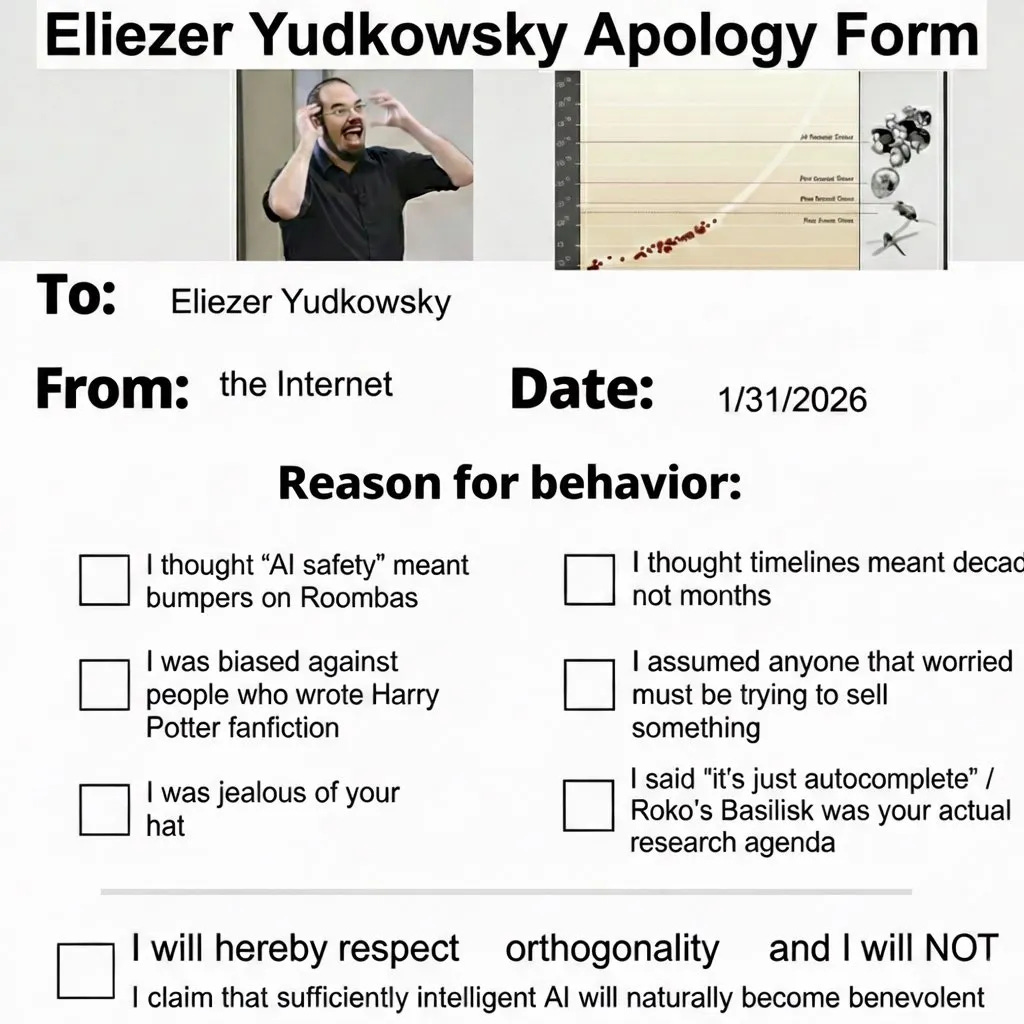
Many of the people earliest to AI were those who took AI safety seriously, and, for all their quirks, they have been correct about an awful lot. Many of the leading figures now pushing the frontier of AI capabilities can trace their intellectual heritage back to LessWrong and didactic Harry Potter fanfiction. And one thing that AI safety people have been saying for years is: it might take longer to build safe AI than it will take to build unsafe AI, so we should try to avoid race dynamics, in which different groups are competing to build the superintelligence first.
You can see the influence of this idea in the actions of the leading labs. It’s embedded in the OpenAI charter. And it reached its apotheosis in Anthropic’s Mythos moment. I said at the time, and continue to think today, that Anthropic’s leadership were acting on their own sincere beliefs about the importance of AI safety. They reached a critical level of AI capability first, and they chose to bear genuine costs—in foregone revenue, in reputation and in conflict with the government—to slow down the release of a new frontier model.


But thinking about safety in terms of the capabilities of a single model may now no longer make sense. In the pre-K3 world, when the gap between closed frontier models and open models was at least six months, there was a good argument to be made for two months of restricted access for cyber hardening. With the prevalence of obvious distillation (Chinese models that answer to Claude, for example, as Kimi K3 still does), there was also a good case that open source models faced a six-month lag from public release. It now seems very possible that the gap could be closer to five months from the moment a leading lab finishes a new frontier pre-train.
How might this change the safety calculus? On the one hand, a responsible frontier lab might still prefer to keep the riskiest capabilities out of the hands of the general public. On the other hand, the larger risk may now come from withholding capabilities from good actors in the knowledge that they will soon be available to bad actors. Project Glasswing or Trusted Access for Cyber might work for 100 companies. Can it work for 10,000?
I think there is something insightful in vie’s post above—the relevant unit of analysis may shift from the individual lab and the individual model to the level of the ecosystem.
I don’t expect this to happen immediately. For the frontier labs it will be, among other things, a communications challenge. There will likely be resistance from teams internally that are rightly focused on ensuring that AI is safe and beneficial technology. But it is hard to escape the conclusion that the relevant counterfactual is no longer, ‘if we don’t release a capability then no one will have it.’
Frontier labs will instead have to reorient around a different possibility. For every new capability, the question will be: how should we act if we expect this capability to be public in two months’ time?
Art of the Deal
This is true for the labs, but it’s also true at the policy level. When the Trump Administration placed an export ban on Fable 5, its stated reason was concern that the model’s cyber capabilities were too easily jailbroken. But the efficacy of this approach rests on the fact that US rivals have no alternative. How should this change if, for example, the next open model release exhibits cyber capabilities close to the frontier?
For risks that are less symmetrical than cyber, where models can be used for both defense and offence, the focal point of regulation may need to change entirely. Fable 5 has, for example, strict safeguards surrounding biology and chemistry. An open-source Mythos might not, and, if it does, they may soon be ablated away. Preventing misuse of such models will likely require more general measures on inputs and precursors, like the one proposed by the IFP and FAI and signed by OpenAI and Anthropic in June.

The China Shock
There is, however, a silver lining in the timing of Moonshot’s release.
No one has a higher opinion of Chinese strategic brilliance than an x dot com China hawk. In the mind of a true China hawk, every policy decision in China is made by Xi himself to undermine the spirit, morale and economy of the US of A. It is therefore no surprise that, in some corners, Kimi K3 and the entire Chinese open source ecosystem are being seen as agents of economic warfare against the big, beautiful buildout. Just like they did to manufacturing in the 2000s. I do not find this particularly convincing.

But I can see one way in which the lessons of deindustrialization might hold for the AI race.
Here is one lens through which to see the China shock: US manufacturing had become so dominant by the end of the 20th century that it had entered a state of stasis. Interest groups, from organized labor to environmentalists, were able to wield significant leverage and influence. Regulations at the state and federal level were set under the expectation that firms had nowhere else to go. Some of this, of course, was good—a profitable company should pay its workers. Negative externalities should be prevented. But, in the absence of competition, there was little to force efficiency or disincentivize rent extraction.
When China, unshackled from decades of poor policy and welcomed into the WTO, began to grow as an industrial power, the US manufacturing ecosystem was no longer flexible enough to react. Stasis created fragility.
This is, of course, a simplification—there was much more to it than that.
But it seems possible to me that the AI safety regime that was beginning to emerge in the US had elements of the same problem. The frontier labs wanted stasis—relative stasis, of course, the pace in an objective sense has been breakneck—and they wanted it for reasons that are good and reasonable. But stasis has a tendency to breed institutions that are invested in continued stasis. Perhaps that path leads to a vetocracy on intelligence like the many well-intentioned efforts that created the vetocracy in housing and infrastructure and energy.
Except that this time, the competitive impulse has arrived before the stasis. US labs, from the frontier down to the newest neolab, are led by incredible talent and are moving extremely quickly. The regulatory environment is also still malleable—some would say too malleable. The shock of an open-source model so close to the frontier may well prompt some reconsideration.
I don’t think Kimi K3 will be the end of frontier labs, or the race between them to train more intelligent, more capable models. In fact, I think we will see a shift—maybe only by degrees—towards a greater focus on the ecosystem, rather than the risk of any single release. We could call it a win for the Hill People.