
What should we do about fertility zero?

TFR Zero
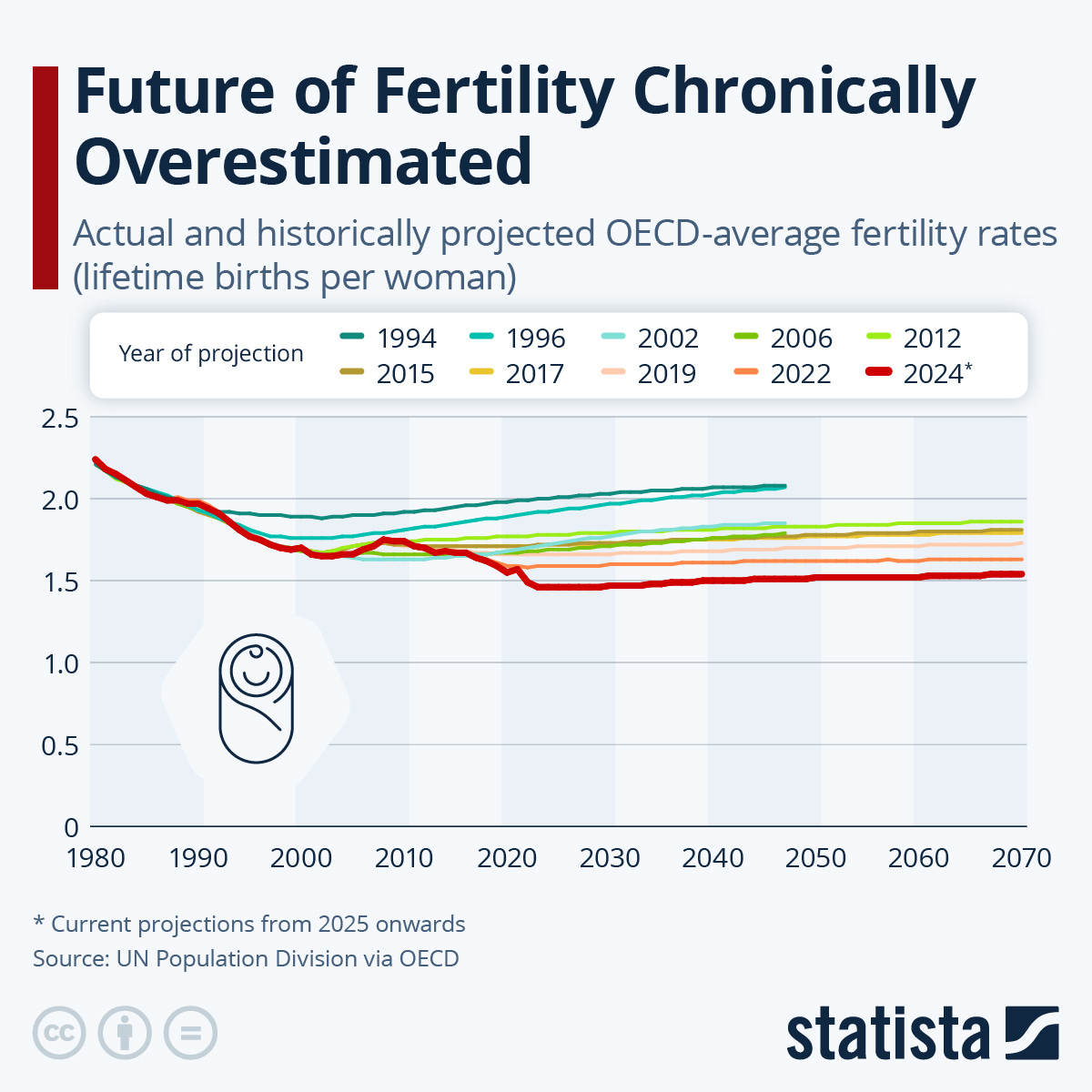
In our conversation on Wednesday, Samo Burja of Bismarck said that we should think seriously about what it might look like to live in a world of TFR 0. Total Fertility Rate is a simple measure of how many children are born to the average woman, and global TFR now sits around 2.2—only just above the replacement rate of 2.1 and down substantially from the 1963 peak of 5.3.

I am very optimistic about the future of humankind—many things really do keep getting better—and I’m also a very happy father of two delightful children. But I think Samo makes a very good point. We really should think more about what it might mean to live in a world where TFR continues to decline, if only to better understand the implications. As Samo pointed out, if you look at the population forecasts of demographers over the last few decades, they keep expecting the decline to level out.
But Samo’s point also raises a more general question—what is going on with birth rates? The chart below plots TFR in the US back to 1860. It is, to my mind, an almost perfect starting point for speculation. It raises three very immediate questions and concerns a central decision in many people’s lives—what kind of family do they want?—that touches on many other areas ripe for discussion: the economy, “kids these days”, relationships and dating and so on.
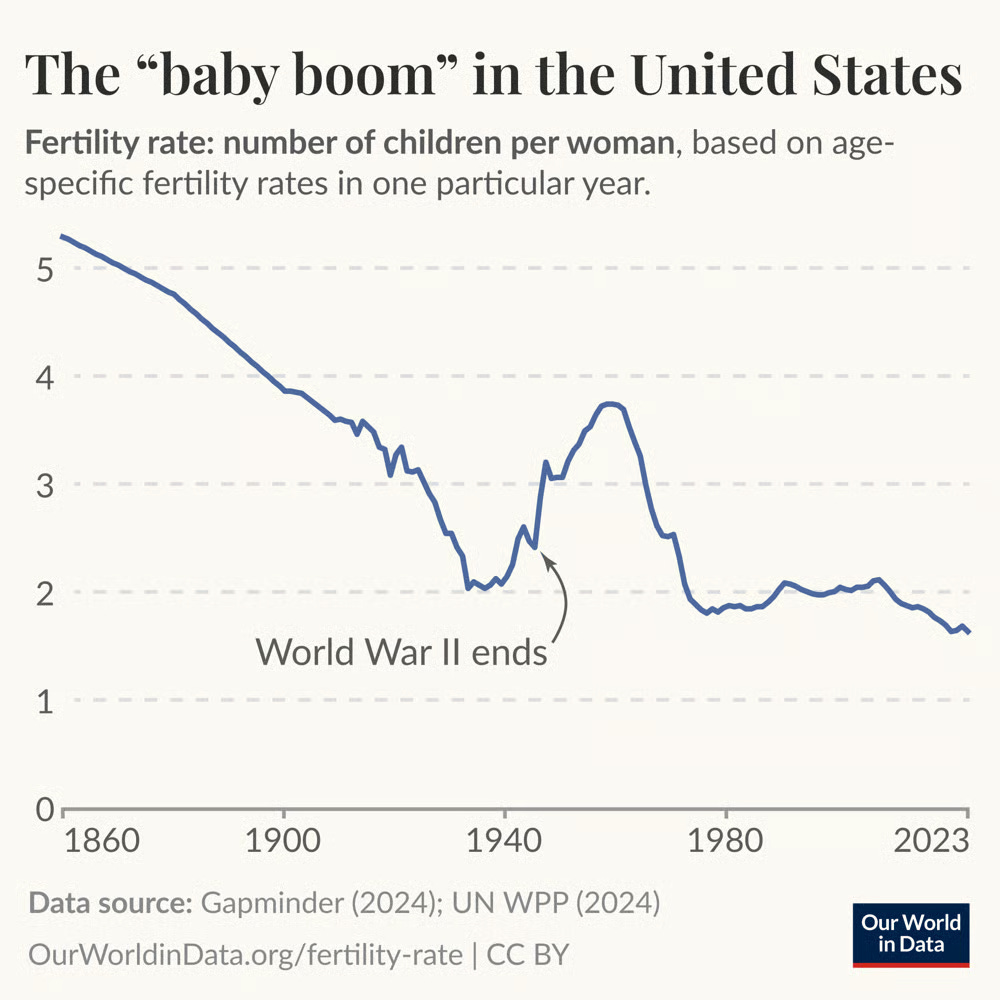
The three questions raised by the chart are, in chronological order:
1. Why were birthrates declining for the 80 years preceding 1940?
2. What caused the Baby Boom? and
3. What is causing the contemporary decline in fertility below the replacement rate?
These questions are hard to answer, and involve many factors. Luckily for me, their appeal has not gone unnoticed, and many serious researchers and pundits have devoted time and effort to understanding them. Thanks to their hard work I have, I think, at least one clear answer. Let’s start with that.
The long decline in birthrates is (partly) about child mortality
I felt very clever the first time I saw a long-run birthrates chart. Often the issue of declining fertility is framed in comparison to the Baby Boom of the mid-twentieth century. When the chart starts in the ‘40s, or even the ‘60s, the temptation is to look for explanations related to post-war modernity. Maybe it’s the microplastics in our balls. Maybe it was Ronald Reagan.
But push the chart back to the 19th century and suddenly it looks like maybe 18th century modernity was to blame. Maybe it was the French Revolution? Unfortunately, as is often the case, I did not feel very clever for long. Lyman Stone, Director of the Pronatalism Initiative at the Institute for Family Studies, has a very pithy explanation for the chart and, as you’d expect, a broader framework for understanding fertility generally. If these questions interest you, you should stop reading this piece and find his substack here.
In his aptly titled There Is No Long Decline in Fertility, Lyman points out that people do not target number of births, which is what fertility measures. They target family size. A big chunk of the pre-Baby Boom decline in US fertility can be explained by the long downward trend in child mortality, truly one of the great blessings of our age. If you account for this trend by looking at surviving family size, the trend looks rather different.
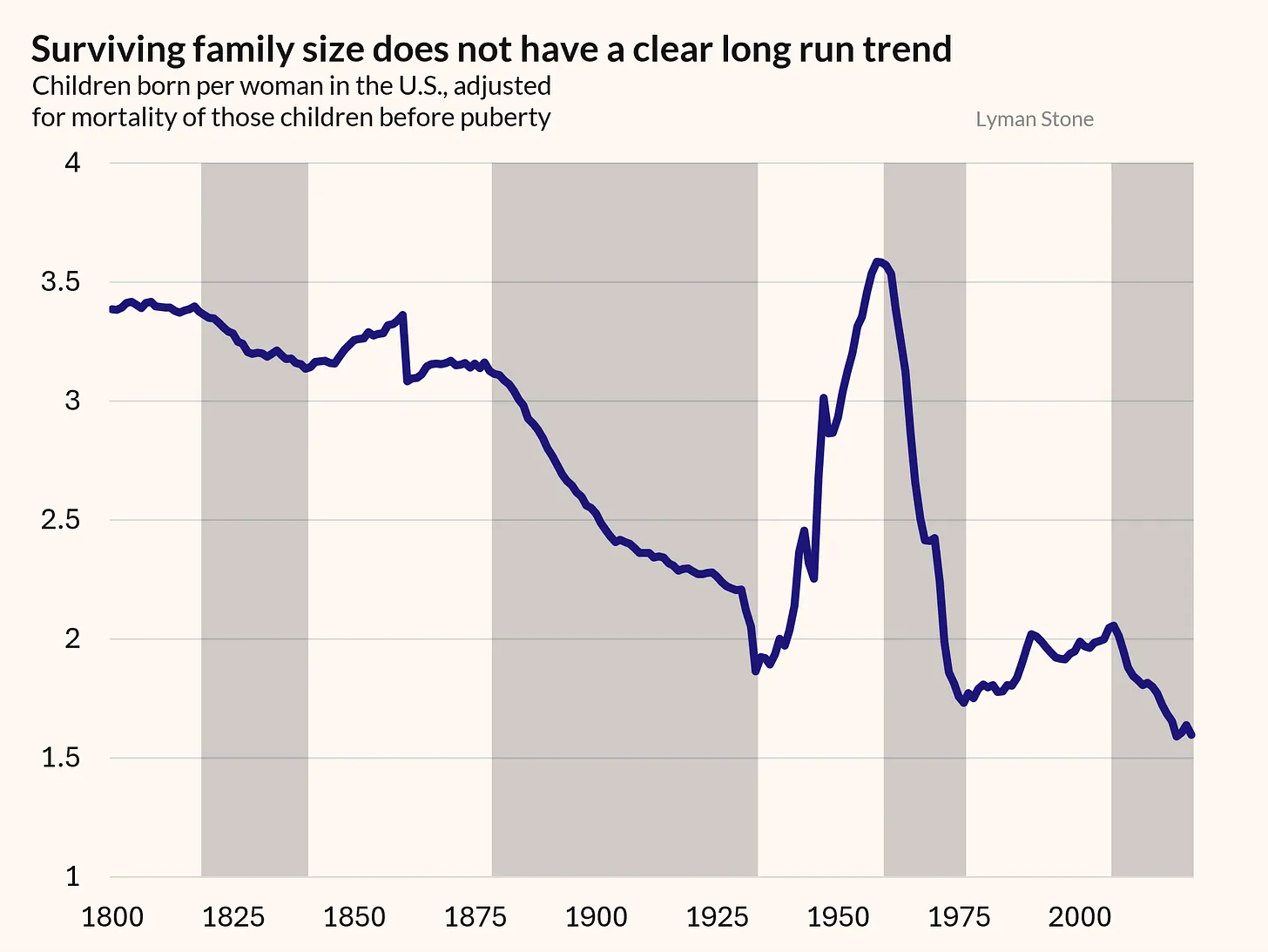
We have now narrowed our first question and raised several others—why were the first 75 years of the 19th century so relatively stable? What happened in 1875? Why did family size decline so sharply after the boom? I don’t know. Next question.
The Baby Boom is weirder than you think
When you look at TFR, the Baby Boom looks like a change in trend, but the peak looks relatively moderate. Births at the peak of the Boom are roughly the same as they were at the start of the century. But adjust that for the incredible improvements in healthcare, and it suddenly becomes clear that Boomer families were the largest they had been since at least 1800 and possibly since records began. What caused Americans to have such large families?
In an excellent piece from a year ago, Derek Thompson goes into the details. He quotes from another wonderful piece on the question from Works In Progress in 2023. Maybe it was modern technology making the job of parenting easier. The introduction of appliances looks like it might have contributed to rising family size. Maybe it was falling maternal mortality. Maybe it was cheap and plentiful housing.
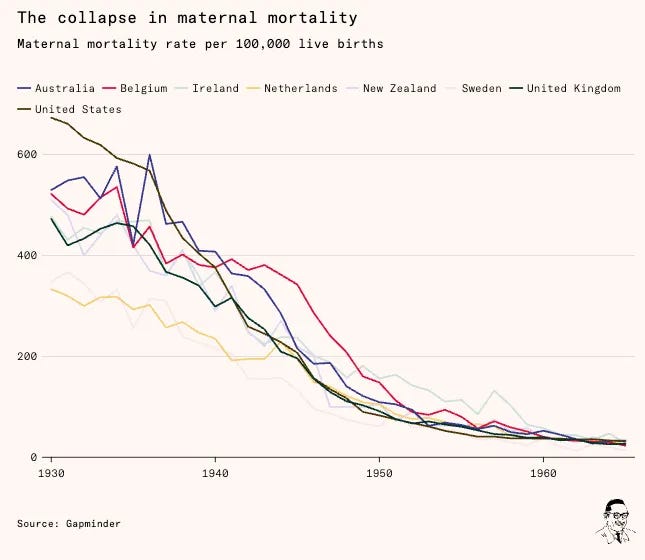
Derek lands on a kind of multi-factor explanation: it was probably all of these things collectively alongside the stark generational improvement experienced by those who were born in the Great Depression and lived to see post-war abundance. Also maybe it was peer effects. And a rise in the status of parenting and homemaking. And the media.
I struggle with this a bit. On one hand, life is complex, things have lots of causes, and these all sound very plausible. On the other hand, the line just went up a lot. This happened across the developed world. It happened to the Amish, who didn’t have appliances. It happened in the UK where women were ‘demobilized’ from the workforce after the war, and it happened in France where they weren’t. Usually when you get a line going up a lot, there is one big reason.
And then the line went down a lot. Electric appliances didn’t stop being useful, mortality didn’t go back up for mothers, and housing didn’t disappear. The material prosperity that might seem intuitively to explain why people were choosing to have more children during the Boom remained but parents returned to having 2.1 children, even as they continued to get wealthier.
And that leaves us with the least quantifiable factors—maybe it was cultural.
Is the fertility decline also cultural?
We return to Lyman Stone. At the end of his piece about the fake long decline in fertility, Lyman puts forward his theory. It’s not (solely) because houses are too expensive, it’s not because of zoomer sexual preferences, it’s probably not because of climate change. It might be because of what Lyman calls a new “selfish norm”. And how did that norm come into being?
To me, the answer is clearly related to the fact that young people are spending way less time socializing independently.
And the answer is clearly related to the fact that fertility decline is extremely age-biased. And the answer is clearly related to the fact that sexual frequency is in firm decline, and marriage is in firm decline and homicide is in decline, and crime generally. In fact basically everything people do together is in decline. “Bowling alone” but on steroids.
What force would simultaneously cause all social life in person to decline?
It’s the phones, folks. It might be the phones.
But there is also a twist here. You might hear “selfish norm” and “phones” and think that implies that instagram reels are causing people to intentionally have fewer children so that they can save their money for Jared Kushner’s new Albanian island eco-resort. Lyman says no.
It turns out that when you ask people how many children they want, the numbers are relatively unchanged. In fact, the gap between stated preferences and family size appears to be growing. Which implies that the problem is not that phones have memed us into traveling, but that, in some grand way, the phones are keeping us apart.
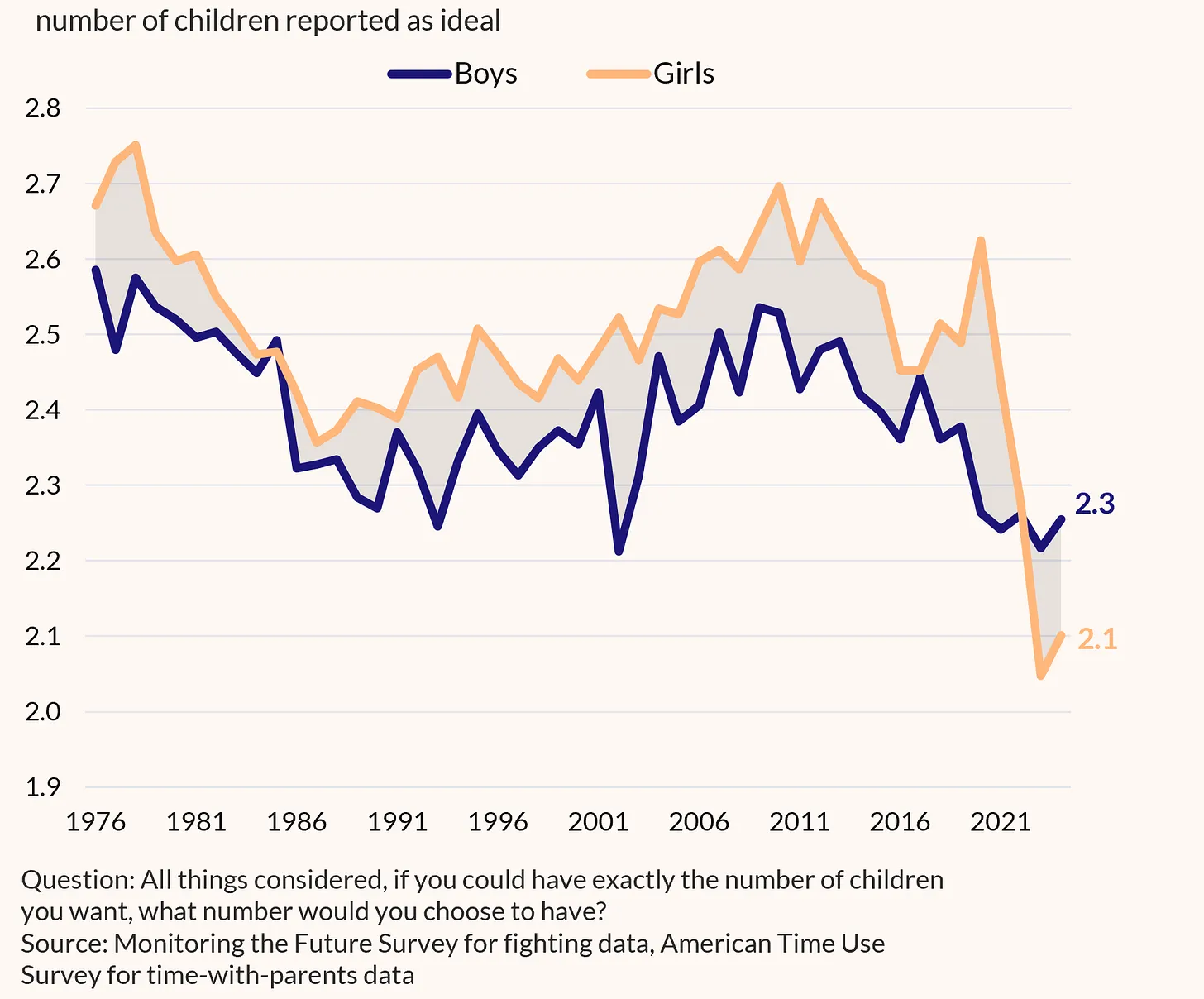
Whitepill: we are the culture
I said at the beginning of this piece that I’m optimistic. I find cultural explanations for these changes rather dissatisfying, but that doesn’t mean they are wrong. And, happily, culture changes. In fact, if you look at the chart of family size as reflecting aggregate decisions that are in some way downstream of culture, then culture has changed dramatically several times in just the last hundred years.
There are green shoots. Fertility in South Korea was up dramatically—8% year on year—in 2025. And we are at the beginning of what feels like a period of dramatic technological progress. Perhaps, in retrospect, this moment of sub-replacement fertility in many countries around the world will look like 1930: the low-point before a rebound.