The Sol Also Rises
OpenAI plans to offer Sol at 750 tok/s. What should we take from this?


Very Fast Picket
Towards the end of the post announcing the GPT-5.6 family of models, first published on June 26, there is one line that is relatively out of place. After talking about the model capabilities (pretty good) and their safety efforts (to ensure it doesn’t get Fabled in the first week), they add that they’ll also be launching the highest tier model on Cerebras, offering 750 tokens/second for a frontier model. That’s around seven times faster than Codex fast (~100 tok/s) and five times faster than Opus 4.8 fast (~150 tok/s).

This is unexpected for two reasons. The first is that the 5.6 family of models are presumably based on an existing pretrain, the same one used for GPT-5.5, and you can’t use 5.5 on Cerebras. The second is that this will be by far the most capable model served on Cerebras’ Wafer Scale Engine chips, which allow you to perform very fast inference but are more memory-constrained than alternatives.


What this seems to suggest to me is that the model was designed around the constraints of Cerebras chips. The Spud pretrain was reportedly completed in March, two months after OpenAI signed a significant deal with Cerebras in January. This would go some way to explaining the popular sense that Anthropic has pulled ahead on sheer model intelligence—the models that OpenAI has been working on since the start of the year had to serve double duty as both their frontier capability offering, and as a test case for the largest model that could be served from super fast inference chips.


What an enormous bet on the value of speed.
Returning to Earth
What about the rest of the GPT-5.6 family of models: Terra and Luna? The three classes of model are intended to offer the ability to trade off capability against cost—Sol is the most capable model, and also the most expensive. There are probably a class of applications for which this is true. But take a look at the early benchmark results OpenAI released. Notice something weird? Sol is not only the best model; for anything more than a roughly $4 API spend, it’s also the cheapest for a given outcome.
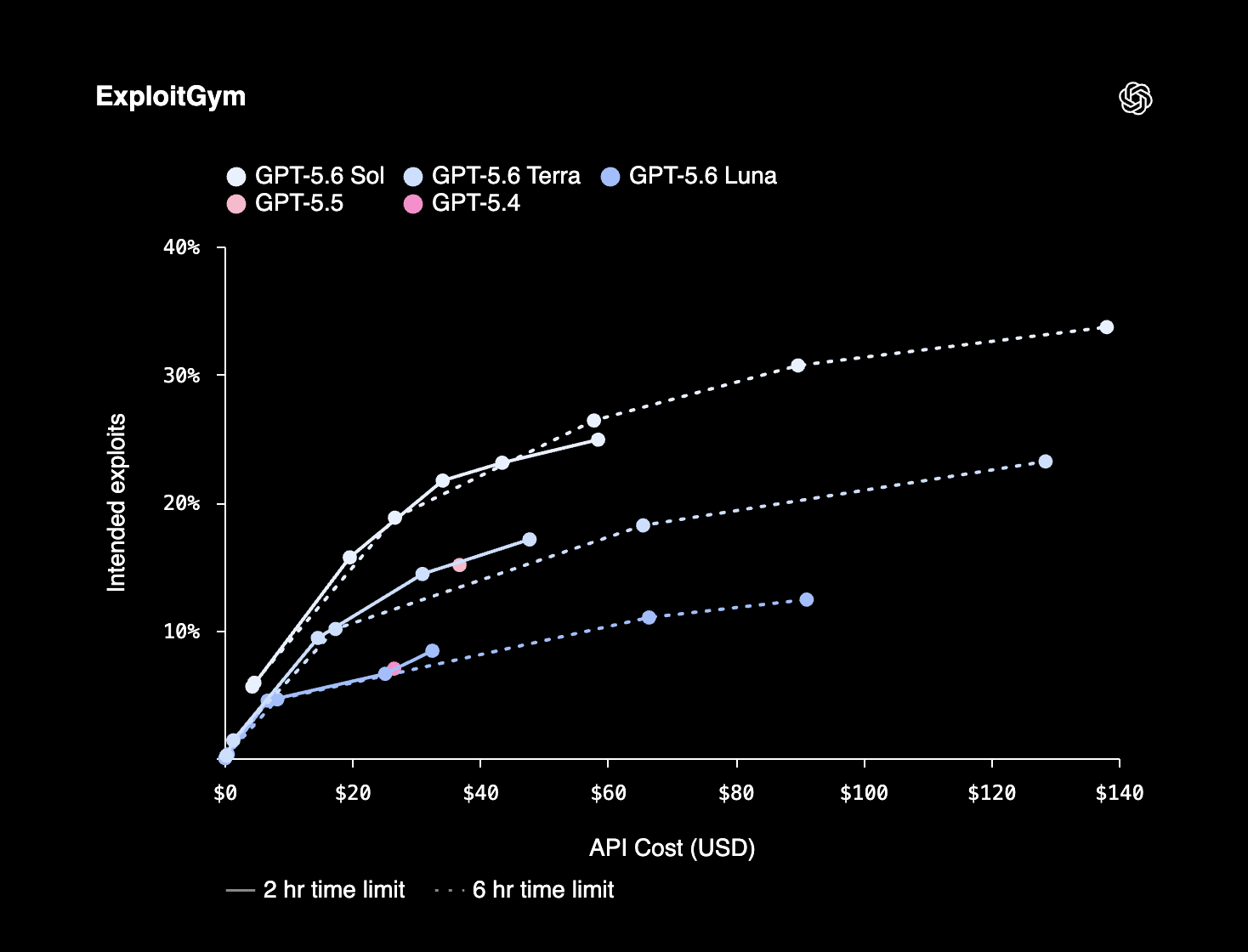
Now in fairness, the two benchmarks in the launch post are GeneBench V1 and ExploitGym. It’s possible that performance on these tasks is hard-capped by intelligence, and that the same dynamic won’t be true for a range of other tasks. But it’s also consistent with a broader strategy that we’ve heard from Sam Altman before—a focus on the pareto frontier, and not just absolute intelligence. I’m not coping, you’re coping.

With the eerie coordination of an NDA being lifted, those with the gift of early access took to X yesterday to share their impressions of GPT-5.6 Sol. Many people, apparently, have been using it for two entire months. What do they think? It’s a good model folks. They’re all good models. We live in the age of machine superintelligence, what did you expect?
The general impression is that Sol is extremely persistent, reliable and capable of long time-horizon autonomy. Many users compared it to Fable 5—generally favorably, in terms of its ability to complete tasks and write code, but with the rather large caveat that Sol does not seem as natively intelligent as Fable. What some people on X call “big model smell”. I know.
One of the reviews I found most interesting was from prinz, below, a lawyer who has constructed a benchmark around difficult legal research questions in his practice area. Fable 5 performs relatively poorly on prinzbench, which prinz attributed to its relatively weak search skills compared to GPT-5.5. GPT-5.6-Sol, however, completely saturates the benchmark. If I had to guess, I would say this is the same set of model characteristics that others have noticed as unusual persistence and autonomy.

If you put these very early capability impressions together with what we can speculate about the path to serving Sol on Cerebras, a certain logic starts to emerge. Noam Brown has spoken at length about the growing importance of test-time scaling. Sam Altman wants cheap, fast models. There’s an opportunity to codesign the next model generation with Cerebras architecture in mind. So OpenAI focus on creating a persistent, detail-oriented model capable of long time-horizon tasks, tool-use, computer use, and sub-agent management that can run at 750 tok/sec.
Next Mission
All of this is pretty cool. The handful of people online who have had access seem to really like Sol. It will likely compare very well to Opus 4.8 and the Gemini models. When served from Cerebras (at a markup), I expect frontier intelligence at 10x speed will feel magical for at least a few weeks. When this was in the planning stage in February, it would have seemed like an absolute coup.

But it turns out that there is some prestige in having the smartest model. Everyone wants what they can’t have, and, for a glorious several months, Mythos was too dangerous to let out of the box. The X rumour mill suggests that OpenAI have their own Mythos-class model in the works, possibly planned for as soon as August.

If that’s true, then it’s possible that we will have two Mythos-class models in Fable 5.1 and GPT-6, superfast Sol and whatever they’re cooking up with Grok by the beginning of Fall. It’s not over yet folks.