
Fable's Iron Curtain


It’s been an interesting few weeks in the world of AI policy.
Frontier models keep getting better. And as they get better, they become what Dario Amodei called in a recent essay “tools of global and national strategic consequence.” That essay, published on June 11 ends with a call to action for policy makers. Emphasis mine.
AI’s exponential progress has created an urgency and a pace of change that the policymaking process is ordinarily ill-equipped to handle. But it has also created a unique window of opportunity. The confluence of clear and present evidence of AI’s risks, an early taste of the AI’s potential for both economic value creation and economic disruption, and a remarkable public backlash against unregulated approaches to AI have created a situation where policymakers are unusually open to forward-looking actions. Treebeard and his forest are waking up.
Don’t ask about the Treebeard thing.
The following day, the Trump Administration issued an export control directive, effectively banning foreign nationals from using Fable 5 or Mythos 5. To comply with the directive, Anthropic suspended access to the models for all users.
Hyperstition, loosely speaking, is a self-propelling idea that makes itself real.
There was some crowing on twitter about this decision. There has long been a case online that Anthropic’s safety concerns are somewhat self-serving—my model is too powerful to serve, I am actually too sexy for this shirt. Perhaps if your model really is a tool of global and national strategic consequence, then it shouldn’t be available for $200 a month to our foreign adversaries? Etc.
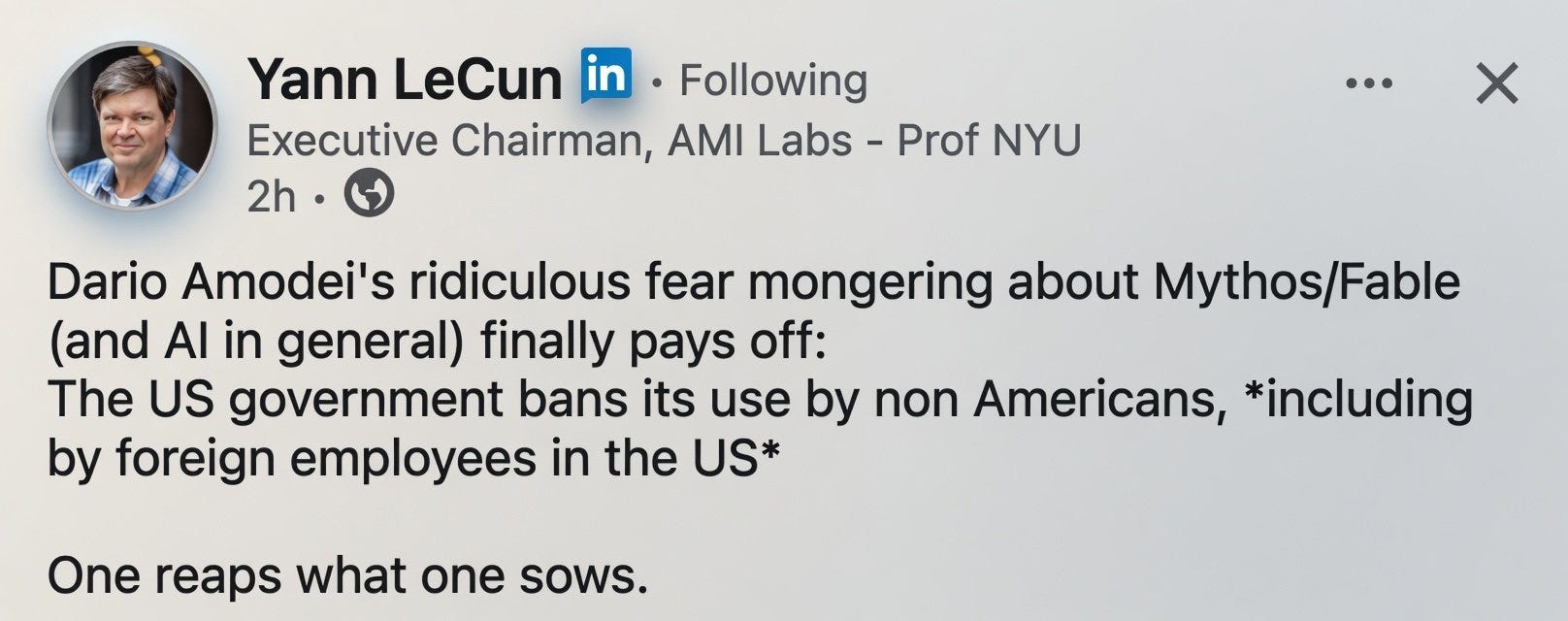
As I’ve said before, although I’m not immune to a certain sense of dramatic irony, I think Anthropic’s leadership is sincere in their beliefs. And I actually think there is a better explanation for why a Dario Amodei blogpost shared on the 11th might have foreshadowed a US government action taken on the 12th: foresight. Amodei, along with many others at the frontier labs and in AI research broadly, was remarkably early to the significance of AI and what advanced models would one day mean for governments and national security.
But reading the reporting, it does seem that the export ban decision was at least partly downstream of what you might call a “personality clash” between Amodei and members of the Trump Administration. In scenes that call to mind the Department of War supply-chain risk designation from earlier in the year, Politico reports that Administration officials encouraged Amodei to pull the model voluntarily, citing “jailbreak” concerns that apparently came from Amazon CEO Andy Jassy. Amodei interpreted this as a technical misunderstanding and tried to clear this up with the officials during the call.
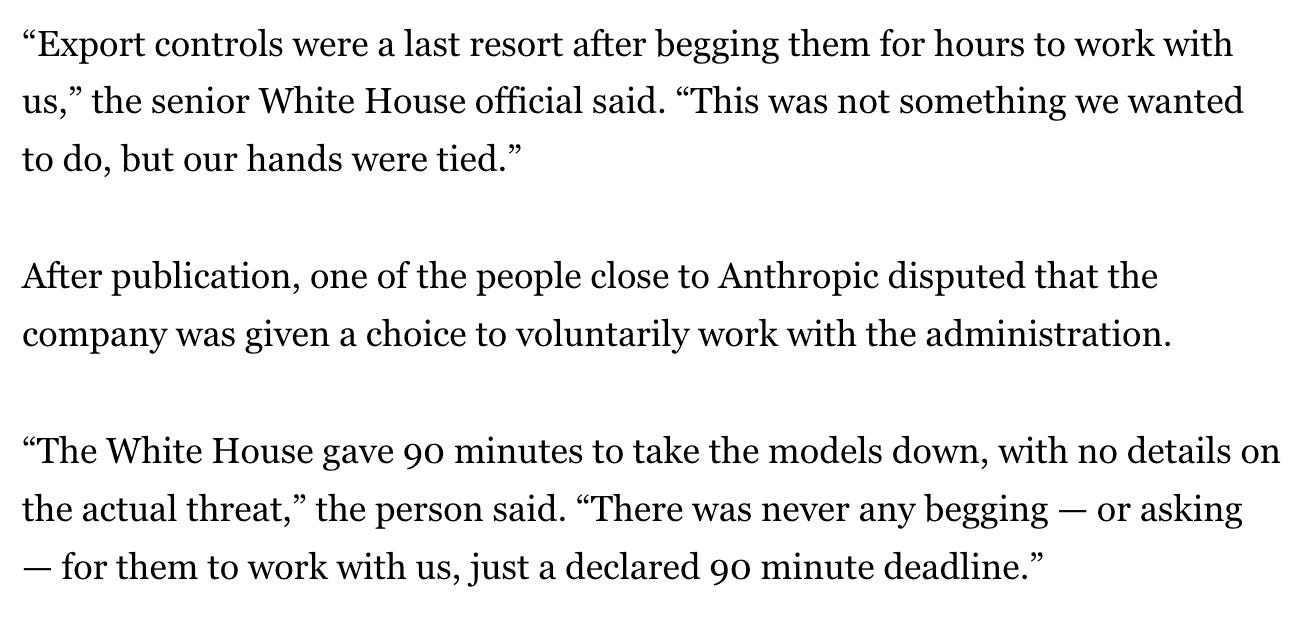
I find it hard to read that reporting and see the Administration as acting in pure and genuine good faith. But it’s also not hard to imagine that a different CEO would have seen that the fix was in, and manoeuvred earlier to at least preserve the perception of peace between Anthropic and the Admin.


What does this mean
The lesson for Anthropic is political. They trained a very good model, and, in accordance with their principles and beliefs, were careful and considered about releasing that model. In their comms, they stressed that this was a very good model that could be quite dangerous (!) in the wrong hands. And the Administration—perhaps sincerely, perhaps to spite Anthropic and Dario Amodei personally—took this literally. It’s not hard to imagine Anthropic facing, unfairly, special scrutiny in the future.
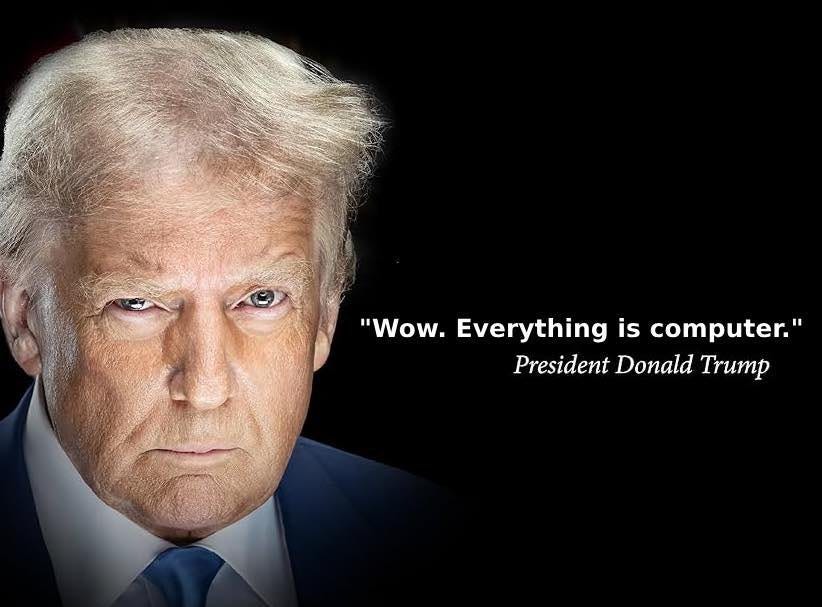
I don’t think Anthropic, or any other lab, should lie about the risks they foresee from new and advanced AI capabilities. But they could, for example, have responded to the initial Administration outreach (misunderstanding or not), by temporarily pulling the model. They could, for example, have made a special Trump Fable (Preview) model for President Trump to personally use, and suggest that he try asking it to “Please hack the NSA. Make no mistakes” and see what happens. That might have been more reassuring that all of Amodei’s protestations and explanations taken together.
But this is all small potatoes. Beyond Anthropic, this export control directive marks an entirely new era for AI regulation. A thin Iron Curtain has fallen into place. The directive suggests that the intent was specifically to restrict access to advanced offensive cybersecurity capabilities. It seems plausible, for example, that a Fable model with improved (add your own scare quotes) cyber safeguards might well be cleared for non-US use.
But the headline effect is to create a literal two-tier global economy: the sphere of the frontier model and the sphere of the sub-frontier. Anthropic has chosen to pull the model for all users, including those in the US. But that decision may be temporary. And if you believe, as the founders of Anthropic and OpenAI and Deepmind seem to, that AI will be an input into almost every industry, that is a substantial advantage for the US, and one that may cause some resentment among US allies.
This distinction is the critical one over the next few months. If the Administration’s policy goal is to keep advanced strategic capabilities out of the hands of rivals, then that is both reasonable and aligned with the stated goals of Anthropic and OpenAI themselves. They pulled this directive together quickly, and so perhaps it was necessarily a blunt instrument. Perhaps a sharper one will be forthcoming. But if the view is going to be that all advanced capabilities (or all advanced capabilities that come from Anthropic) need to be US-only, that is a substantially bigger change. Either way, I expect we will find out.