
7/16: Kimi K3
Kimi K3 is finally out, TSMC increases investment + outlook, new Japanese AI co Noetra, CXMT IPO oversubscribed

Happy Thursday, monitors. It’s an incredible day for open-source models — Kimi K3 is stunningly good. We’re monitoring live on MTS: be sure to catch us on X and YouTube, and join our Discord to chat with our hosts.
Today’s Experts
Jonah Weinbaum (Institute For Progress)
Augusto Marietti (Kong)
Ian Rogers (Ledger)
Shanu Mathew (investor/analyst)
John Glasgow (Campfire)
Dr. John Slotkin (Gleisinger)
Quinn Slack (Amp, Sourcegraph)
Lin Qiao (Fireworks AI)
Guanlan Dai (Runta)
Making Sense of the World
Kimi K3
After weeks of teasing, Moonshot AI has finally released its long-awaited model, Kimi K3, and it’s, uh, really good.
For starters, it ranks substantially above even Fable on Arena’s Frontend Code Arena benchmark, to say nothing of Sol, Opus, Grok, and other frontier models.


On other benchmarks, it performs generally similarly to Sol and Fable and strictly superior to GPT-5.5 and Opus 4.8.
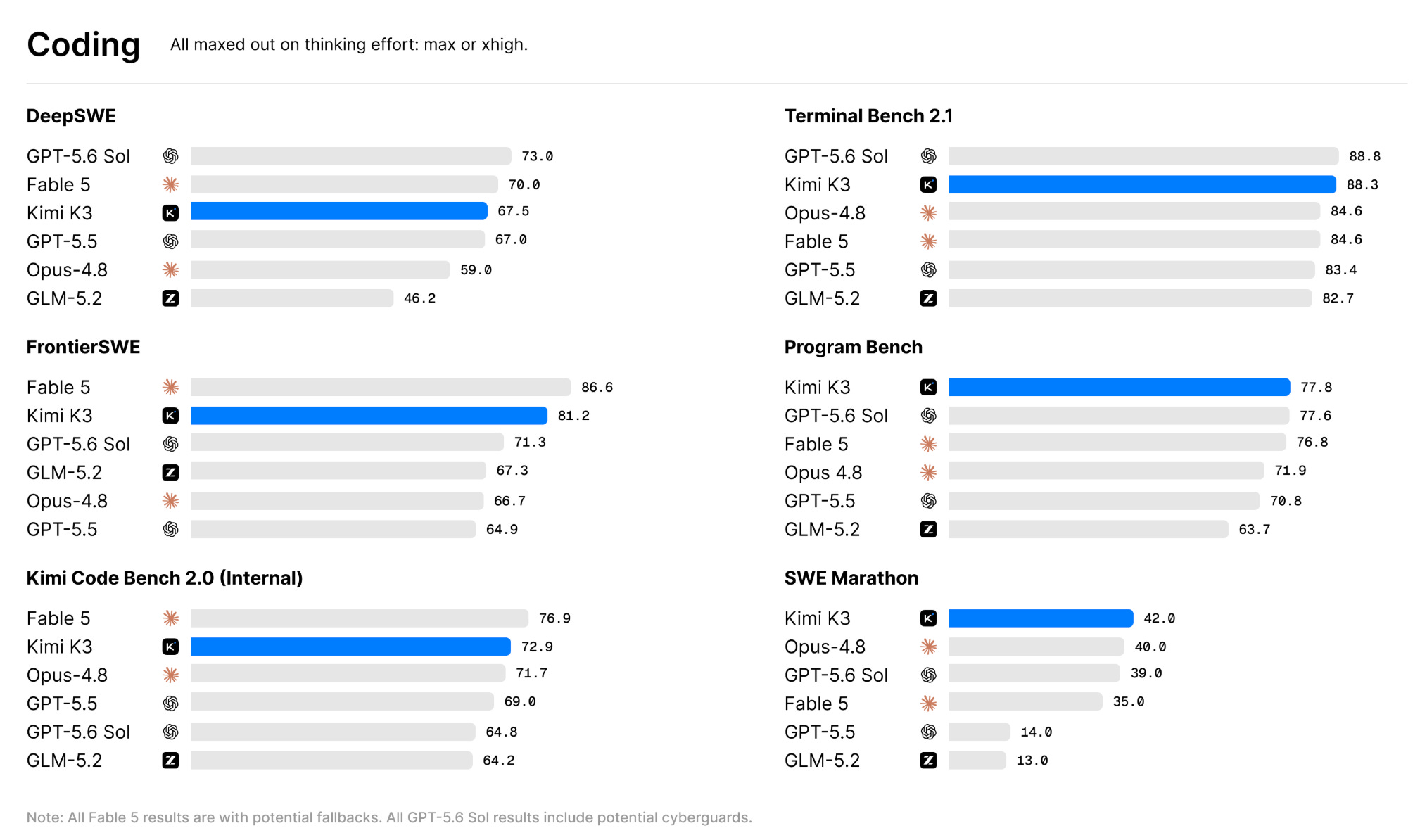
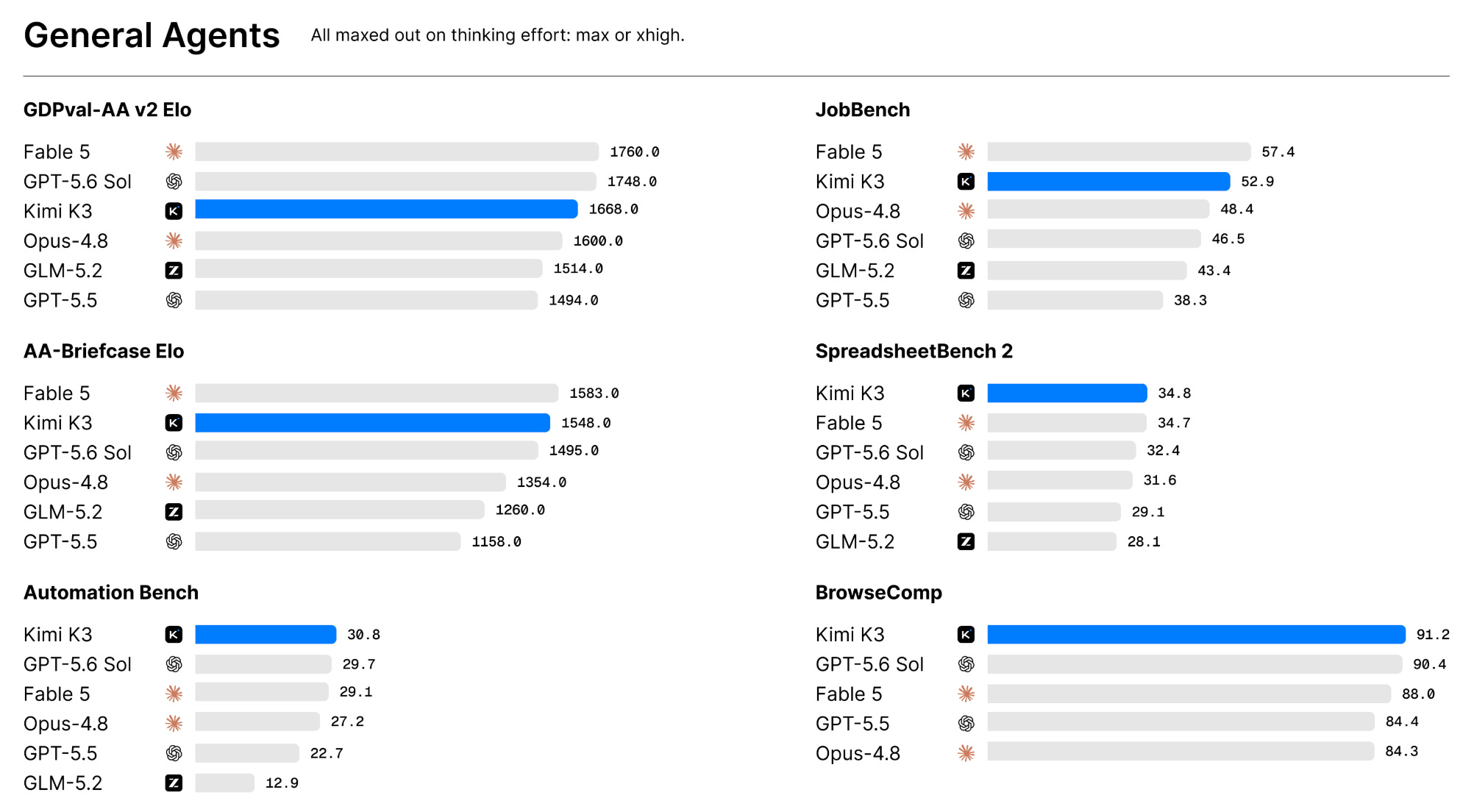
The blog post is full of incredible examples of the model doing things like putting a working GameBoy emulator inside a working 3D model of a GameBoy, cloning simple but still impressive versions of games like Spider-Man, Assassin’s Creed, and Universe Simulator, making professional presentations and reports about detailed technical subjects, and even editing its own teaser video. In one example, it designed, optimized, and verified a chip to serve a small model based on its own architecture, and made a working 3D visualization of it, in a single run.
On top of all that, it’ll be open-weights by July 27, making it by far the best open-weights model ever. Also the largest, at 2.8 trillion parameters. And with all of these near-Fable-level capabilities, it’s priced around the same as Sonnet: $3 per million input tokens and $15 per million output tokens1. So how did we get here?
Moonshot AI was founded in March 2023, the same month GPT-4 was launched, by three classmates from Tsinghua University, the same university that spun out Z.ai. It’s based In October, they released the first version of their open-source AI model Kimi. The following February, they raised $1 billion at $2.5 billion, led by Alibaba. Moonshot kept releasing better Kimi models: Kimi K1.5 in January 2025, the 1T parameter Kimi K2 in July, Kimi K2 Thinking in November, and K2.5 in January 2026 with native multimodal and “agent swarm” capabilities. They’ve recently raised $2 billion at $20 billion, led by Meituan2, and if investors believe Kimi K3 is truly Fable-level, their valuation could go a lot higher than that.
Regardless of whether it’s “truly” better than Fable, it’s much better than expected, both for China and for open-source. As we said on stream, if OpenAI and Anthropic were publicly traded, they would probably be significantly down on the news of a far cheaper competitor model. It’s hard to imagine that enterprises continue paying $10/$50 for Fable when they can get similar capabilities for $5/$15, or, for sufficiently large enterprises, just the amortized cost of hardware and power thanks to the open weights. Yes, there have been many false starts with Chinese open-source models before, but this one appears to be a true frontier-class model, even more so than Z.ai’s GLM-5.2.
Many people expect China to eventually stop open-sourcing models once they reach a certain level of capability. Evidently, this hasn’t happened yet. But policy responses from the US or China are not off the table. We saw how the US government reacted to Mythos/Fable’s cyber capabilities. If they determine that Kimi K3 poses a similar threat, they might respond in kind. Or it might take until the next level of open-source capability, or maybe not for a while. Time will tell, and we’ll be monitoring the whole way.
More Stories
TSMC raises its outlook. The semiconductor manufacturing giant expects to spend $60-64 billion a year on capex and is projecting over 40% year-over-year revenue growth. It reported a 77.4% increase in quarterly net income. TSMC also announced an additional $100 billion investment in US chipmaking capacity, increasing the total to $265 billion, in order to reduce reliance on Taiwan.
Japan creates an AI consortium, Noetra, to eventually build physical AI models. Participating organizations include Sony, SoftBank, NEC, Honda, Fujitsu, Hitachi, Mitsubishi, Sakana AI, and Toshiba. Noetra has been allocated $2.4B in government funding, which it will use to buy tens of thousands of Nvidia Vera Rubin chips.
China establishes an international AI organization. The World AI Cooperation Organization (WAICO) has 29 founding members, including Russia, Indonesia, Pakistan, Brazil, South Africa, and Vietnam. WAICO seeks to promote international cooperation on AI governance and standards, much like the hypothetical US-led consortium proposed by people including Sam Altman and Demis Hassabis3.
Gemini 3.5 Pro is delayed, again. Google DeepMind’s latest frontier model is nowhere to be found nearly two months after the release of Gemini 3.5 Flash and five months after 3.1 Pro. GDM’s public models are now behind Anthropic, OpenAI, Meta, xAI, Z.ai, and Moonshot, and possibly ByteDance, DeepSeek, and MiniMax. Multiple top researchers have left the org in recent weeks, including Gemini’s co-lead, Noam Shazeer, now at OpenAI.
Dario Amodei donates $1M to pro-AI regulation super PAC Public First, which supports transparency legislation and export controls on chips to China and opposes preemption of state AI laws. Other Anthropic employees contributed $1.26M, and Anthropic itself previously donated $20M. Public First has often clashed with anti-AI regulation super PAC Leading the Future, backed by Greg Brockman and Marc Andreessen. This is Amodei’s first major political contribution.
CXMT’s IPO is 212x oversubscribed for retail investors. The Chinese memory giant saw 9.4 million orders from individual investors, far more than the shares available. Also, Rep. John Moolenaar (R-MI), the chair of the House China committee, has urged the Trump administration to ban American firms from buying memory chips from CXMT and Wuhan-based YMTC (Yangtze Memory Technologies Corp).
Demis Hassabis will lobby lawmakers on his AI governance plan, a FINRA-style regulatory body to evaluate models for potentially dangerous capabilities.
Nikita Bier announces more changes to the X creator revenue share program, including banning solicitation of engagements (e.g. “I’ll follow everyone who replies”) and giving any money earned on duplicate content to the original creator.
PayPal’s board sees Stripe and Advent’s $53B acquisition offer as inadequate. PayPal’s market cap peaked at $356B in 2021, on par with Mastercard at the time and greater than Bank of America and Morgan Stanley. It has since slid due to increased competition.
Fireworks AI raises $1.5B at $17.5B, led by Atreides, Index, and TCV after surpassing $1B in ARR. Fireworks provides inference, training, and RL to enterprises. CEO Lin Qiao came on MTS to tell us all about it!
Claude Sonnet 5 is priced at a promotional rate of $2/$10 through August 31, after which it will increase to standard pricing of $3/$15.
Both Alibaba and Meituan have their own language models — Alibaba’s Qwen series and Meituan’s LongCat series. This is sort of similar to how Google is an investor in Anthropic.
If the US-China AI race is the second Cold War, perhaps this is the Warsaw Pact to the US’ NATO.