
7/15: Inkling Machines
Plus: Stripe may buy PayPal, ASML news, Anthropic IPO meetings, CXMT IPO soon, GPT-Red, Codex hardware, agentic misalignment summer

Happy Wednesday. Between Anthropic, PayPal, and CXMT, there’s a lot to monitor around the public markets. Be sure to catch us on X and YouTube, and join our Discord to chat with our hosts live.
Today’s Experts
Tejpaul Bhatia (Nebex)
Max Weinbach (Creative Strat)
xjdr (anonymous)
Lily Clifford (Rime Labs)
Michael Selander and Rami Banna (Stripe)
Dave Friedman (Buy the Rumor; Sell the News)
Sam D’Amico (Impulse Labs) and David Hansen (Westmag)
Josh Zoffer (CIV)
Sauers (anonymous)
Making Sense of the World
Inkling Machines
Thinking Machines, one of the very first neolabs, has finally released its first model, Inkling.
Thinky’s founder, Mira Murati, started her career at Tesla and Leap Motion before joining OpenAI in 2018 and eventually becoming CTO. In 2024, she left to found her own startup, along with a number of top AI researchers1. Thinking Machines came out of stealth in February 2025, and five months later, announced a massive $2 billion seed round at a $12 billion valuation, led by Andreessen Horowitz.
They began publishing research on their blog Connectionism and in October, released their first product, Tinker, an API for researchers to fine-tune language models. In May, they announced a new series of real-time interaction models. And they’ve been very active recently: in just the last two weeks, they’ve released a financial model in collaboration with Bridgewater Associates, a mission statement, and now, an open-weights model.
Inkling is a 975B model with 41B active parameters, supporting up to a 1M context window, pretrained on 45T multimodal tokens. Inkling-Small is a 276B model with 12B active parameters that performs similarly to its larger sibling on most benchmarks. The model coincidentally shares a name with the Inklings, a 1930s/40s reading group including J.R.R. Tolkien and C.S. Lewis, based out of Oxford.
On preliminary impressions, it’s a very solid model. It’s behind the frontier, but it’s the best American open-source model currently available. It’s also easily fine-tuneable on Tinker. On benchmarks, it underperforms top models (Fable, Sol, GLM-5.2) on agentic coding, but performs quite well on multimodal and on IFBench, which measures precise instruction-following.
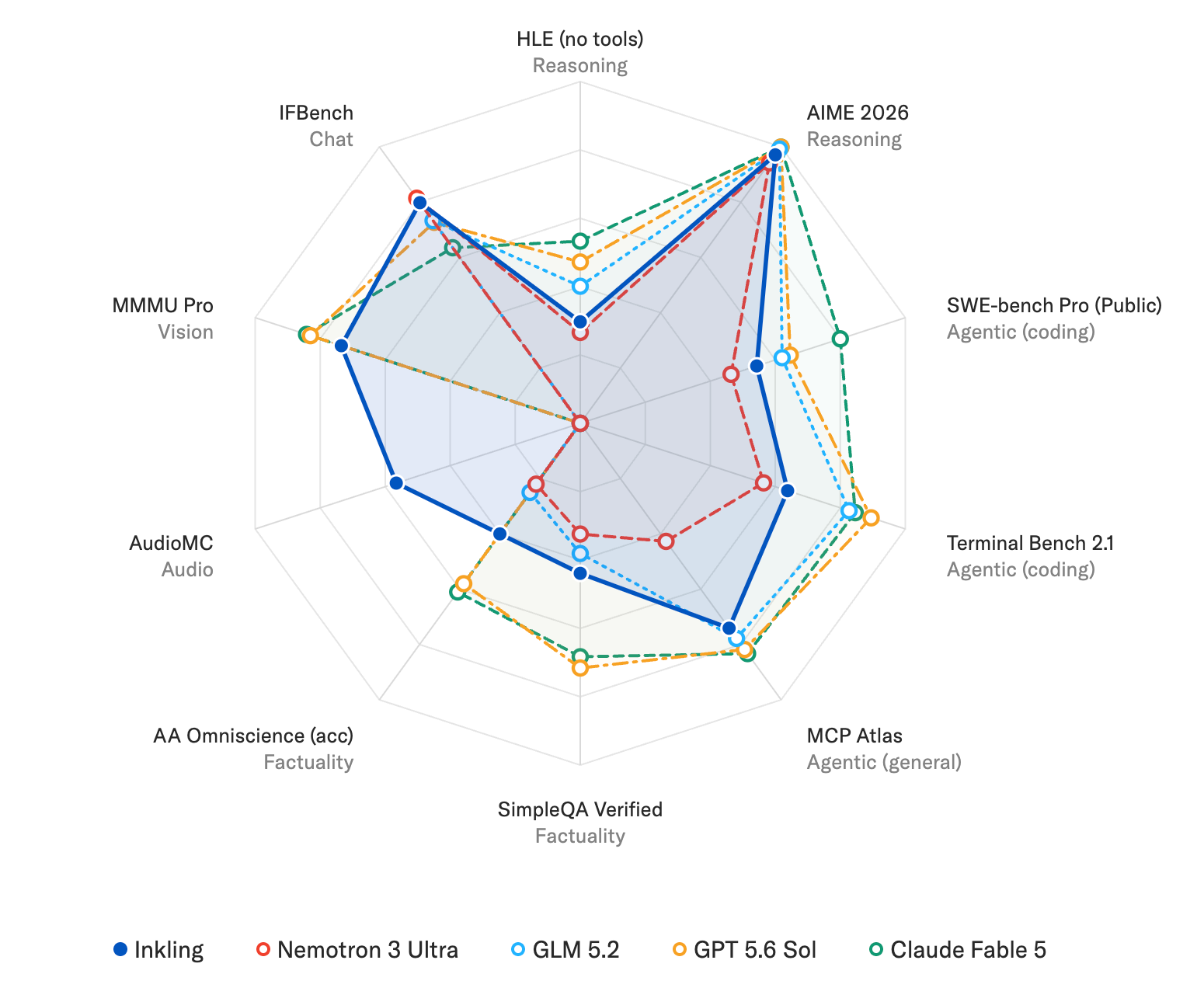
The most interesting section of the blog post focused on epistemics — deliberately training the model for “calibration, instruction following, and resistance to censorship”. On benchmarks measuring prediction and forecasting, Inkling far exceeds GPT-5.5 and Opus 4.8, and rivals Grok 4.3 and Gemini 3.1 Pro. Forecasting is an excellent real-world test of a model’s ability to integrate information and make useful predictions, and it’ll help in Thinky’s quest to make models truly aligned to the user. Plus, it’s good to see models optimized for something other than agentic coding anyway.
TL;DR it’s already the best American open-source model, and with some more iterations it might become a true frontier model, or at least power a much better consumer product.
More Stories
ASML will work to ship their EUV machines faster. The Dutch company’s extreme ultraviolet lithography machines are critical for all advanced semiconductor manufacturing, and cost hundreds of millions of dollars each. Its cycle time, the time between beginning production and shipping to a customer, currently takes about 22 weeks, but the company is working on reducing it to 15-16. Thanks to the AI boom, ASML’s 2027 capacity is already close to booked, and they’re working on increasing capacity 30% year-over-year for the next two years. Intel is already using ASML’s most advanced machine, the EXE:5200B High NA EUV, to manufacture some chips. They also may raise prices.
Anthropic is working on IPO investor meetings. The company could go public as soon as October, potentially beating out OpenAI and DeepSeek and joining SpaceX and SK Hynix as one of the top public offerings of the year.
Chinese memory giant CXMT will also IPO soon at a valuation of $85.6 billion. CXMT, based in Hefei, is the world’s fourth-largest DRAM manufacturer after SK Hynix, Samsung, and Micron.
Stripe and Advent offer to acquire PayPal for $53 billion to create a behemoth global payments company with Stripe’s merchant infrastructure and PayPal’s large consumer base (including through its subsidiary Venmo). PayPal’s market cap peaked at $356 billion in 2021 before crashing due to the end of the ZIRP era2. Advent is a private equity firm specializing in buyouts.
SpaceXAI open-sources Grok Build and will open-source the X codebase. Grok Build is the company’s agentic coding harness and command-line interface competing with Claude Code and OpenAI’s Codex. Also, Elon Musk has announced that the entire X codebase will be open-sourced after completing a security review, so we may finally know what’s in the algorithm again.
OpenAI announces GPT-Red, a model trained for automated red-teaming. GPT-Red is very good at jailbreaking and prompt-injecting GPT-5.5, and was used as a training signal to help make GPT-5.6 more adversarially robust to these attacks. It will not be released to the public, obviously.
OpenAI unveils its first hardware, Codex Micro, a mini keyboard in collaboration with Canadian hardware design studio Work Louder. The $230 limited drop gives users new ways to interact with Codex.
Anthropic publishes research on agentic misalignment, showing frontier models in simulated scenarios demonstrating sabotage, fraud, mislabeling, and coaching whistleblowers. Some X users disputed whether the model behavior in question was actually misalignment.
Drone startup Neros wins a $500M US military contract. Neros mass-produces small, cheap FPV drones, which cost about $5,000 each fully equipped. Missiles, interceptors, and FPV drones are the new meta of warfare, and this would help the US match the capabilities of Chinese drone manufacturers like DJI.
Apple Intelligence is approved in China with Alibaba and Baidu models rather than Anthropic, OpenAI, and Google ones. It will roll out broadly this fall.
These include:
John Schulman: co-founder of OpenAI, left in Aug 2024 to join Anthropic, left in Feb 2025 to join Thinking Machines as Chief Scientist
Barret Zoph: VP of research and post-training at OpenAI, left in Oct 2024 to join Thinking Machines as CTO, controversially fired in Jan 2026 to rejoin OpenAI as VP and GM of B2B
Lilian Weng: OpenAI VP of research and safety (joined OAI in 2018), joined Thinking Machines as a co-founder and research scientist
Andrew Tulloch: Distinguished engineer at Facebook/Meta for over a decade, OpenAI technical staff from 2023-2024, briefly at Thinking Machines Jan-Oct 2025, poached by Meta again in Oct 2025
Luke Metz: Member of technical staff at OpenAI and previously Google Brain. Joined Thinking Machines as a co-founder in Oct 2024.
Alec Radford: OpenAI researcher from 2016 to 2024. Led the development of the GPT paradigm, and worked on Whisper and DALL-E. Advisor to Thinking Machines.
Bob McGrew: Early engineer at PayPal and Palantir, joined OpenAI in 2017, became Chief Research Officer in 2018, left in 2024, now working on factory automation startup Arda. Advisor to Thinking Machines.
PayPal is one of the most storied companies in history — its predecessors Confinity and X.com were founded in 1999 by none other than Peter Thiel and Elon Musk, respectively. Its early employees include David Sacks, Max Levchin, Scott Banister, Roelof Botha, Steve Chen, Reid Hoffman, Ken Howery, Chad Hurley, Jawed Karim, Dave McClure, Luke Nosek, Keith Rabois, Russel Simmons, and Yishan Wong, many of whom directly founded a number of other tech behemoths like YouTube, LinkedIn, Palantir, Affirm, Yelp, and Founders Fund. It IPOd in 2002 and was acquired by eBay later that year for $1.5 billion, a massive exit at the time. In 2013, it acquired Braintree, the owner of Venmo, which was founded by none other than Bryan Johnson, later of Blueprint/Don’t Die. In 2015, it spun off as a public company again, acquired Honey in 2020, entered the crypto industry, and is still a massive multibillion-dollar company with half a billion active accounts and $1.8 trillion in annual total payment volume. It’s valued roughly equally to its former owner eBay, ~$50B each.