
6/16: Chinese open-source is closing in
Z.ai releases GLM-5.2, DeepSeek raises, OpenAI financials leak, new Apple and Snapchat hardware

It’s Tuesday, monitors, and we’re back in the Situation Room with Gabriel, who came all the way from Australia. Be sure to catch us on X and YouTube, and join our Discord to chat with our hosts live.
Today’s Experts
Jamie Siminoff (Ring)
Ben Black (Powerlaw Corp.)
Aaron Slodov (Atomic Industries, Reindustrialize Summit)
Aghi Marietti (Kong)
Paul Sankey (Sankey Research)
Steve Hou (Silicon Data)
Craig Fuller (FreightWaves)
Nathan Leamer (Fixed Gear Strategies)
Making Sense of the World
New frontier model released by… Z.ai?
Today, Chinese startup Z.ai1 just released GLM-5.2, an open-source model closer to the frontier than any other in history. I know you’re probably used to hearing about benchmaxxed open-source slop models that don’t come anywhere close to the intelligence, generality, and “big model smell” of the latest GPT or Claude, but this one is different.
For starters, it’s ranked higher on the Agent Arena leaderboard than any other model aside from a few recent GPT, Opus, and Fable models, and higher than any other open-source model by far:


On most evals tested, GLM-5.2 outperforms all models except for Fable, GPT-5.5, and Opus 4.8. On Design Arena it outperforms all of them, even Fable.
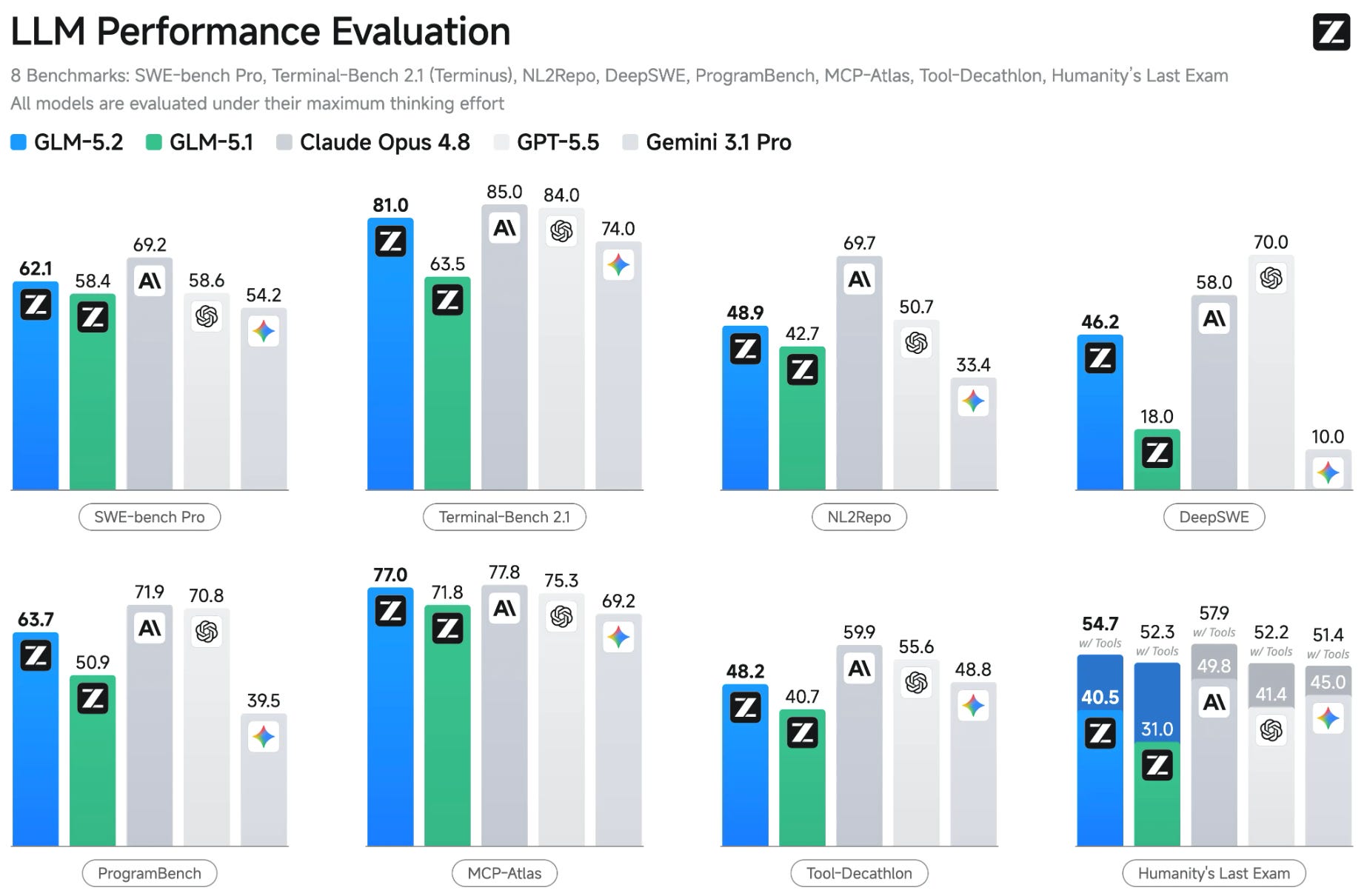
It’s the same price as GLM-5.1, $1.40/$4.40 per million input/output tokens, comparable to Claude 4.5 Haiku and GPT-5.4 mini but much better than either. And it’s fully MIT-licensed, open-weights, and you can read a technical blog post explaining its improvements over its predecessor.
So what is Z.ai, and where did they come from?
Z.ai was founded in 2019 in Beijing’s Zhongguancun district, a major tech hub in the northwestern part of the city that’s also home to Lenovo, Baidu, ByteDance, JD, Meituan, Kuaishou, DiDi, Moonshot, and more; in close proximity to Tsinghua University and Peking University, two of China’s top universities. Its founders, Tang Jie and Li Juanzi, are computer science professors at Tsinghua. Tang is a vice director of the nonprofit Beijing Academy of Artificial Intelligence (BAAI) research lab and the doctoral advisor of Yang Zhilin, co-founder and CEO of Moonshot AI. Li ran the Knowledge Engineering Group at Tsinghua, which incubated Moonshot and several other startups. CEO Zhang Peng is a Tsinghua alumnus who’s been in academic computer science research for 25+ years.
In 2021, the Beijing Academy of Artificial Intelligence released Wu Dao, a 1.75 trillion-parameter large language model, ten times the size of GPT-3. At the time, it was the largest LLM ever. Tang and many others on the team contributed to the model, and Z.ai was founded in part to commercialize the research behind it. The following year, Z.ai released its first iteration of its General Language Model (GLM). GLM-4 was released in January 2024, and GLM-5 followed two years later. In January 2026, the company went public on the Hong Kong Stock Exchange with a market cap of $6.8 billion. Today, just five months later, it’s worth $83.9 billion.
In January, Epoch reported that Chinese models have lagged the US frontier by an average of 7 months since 2023. With GLM-5.2 now roughly on the level of Opus 4.7, this gap may have shrunk to as little as two months. In the eternal AI race, you can never rest on your laurels.
More Stories
DeepSeek raises $7.4B at more than $50B, its first external capital raise. Investors are required to put their capital in a limited partnership personally managed by CEO Liang Wenfeng, will not have voting rights, and will not be able to sell their stakes for five years. Liang contributed $3 billion of his own money. Other investors include Tencent ($1.5 billion), CATL ($750 million), JD.com, NetEase, and IDG Capital ($440 million each), and the Chinese government’s National AI Industry Investment Fund ($150 million), which will not be subject to the restrictions of other investors. Liang’s team personally checked the identities of every limited partner of every fund involved in the round.
OpenAI’s financial information leaks. In 2025, the company made $13 billion in revenue and spent $34B, including $7.5B on cost of revenue, $19.2B on R&D, $5.7B on sales and marketing, and $1.6B on general and administrative. Aside from accounting technicalities and non-cash expenses, OpenAI lost $8 billion in 2025. The profitability J-curve is still rising.
Commerce Sec. Howard Lutnick’s letter to Anthropic is released, ordering the company not to grant access to Mythos 5 or Fable 5 to non-US nationals, whether inside or outside of the US, without a license from the Commerce Department, until further notice.
France moves toward sovereign tech. Prime Minister Sébastien Lecornu announced that DGSI, France’s FBI equivalent, will cancel its contract with Palantir in favor of French startup ChapsVision. Also, French workers will be given access to a Mistral-powered AI assistant, and an additional $760 million will be invested in AI through 2030 (notably, a tiny fraction of what China and the US are investing in AI). Especially in light of US export controls on the most advanced Anthropic models, Europe-US relations on tech are straining.
Apple is planning camera-equipped AirPods for 2027. Bloomberg’s Apple leaker extraordinaire Mark Gurman says that the cameras will act as sensors to feed visual context into Siri so users can ask questions about their environment. Apple’s long-rumored smart glasses may also release as early as late 2027, and they are considering making a smart pendant with a camera. This year, we’ll see the iPhone 18 Pro and Pro Max, and Apple’s first foldable iPhone. Next year, we’ll get the base model iPhone 18 and a 20th anniversary iPhone2 featuring an edge-to-edge display with curved glass wrapped around the sides.
Snap launches Specs, a $2,195 pair of AR smart glasses with advanced displays and cameras, set to ship this fall. They take a centrist position on the eternal VR/AR dichotomy of having either lightweight, wearable glasses with less functionality or bulky headsets with more functionality but less aura. The first generation of Snapchat Spectacles launched in late 2016.
Today’s Drop
In late 2025 and early 2026, we’ve seen an explosion of interest in personal agents — LLM-powered software that can write code and do things on your computer.
We explain what they are, what you can do with them, and why they matter at our latest drop: drops.mts.now/personalagents.
Banger Review


Formerly known as Zhipu AI, known in English as “Knowledge Atlas Technology Joint Stock Co., Ltd.”, known in Chinese as 北京智谱华章科技股份有限公司 (“Beijing Zhipu Huazhang Technology Joint Stock Limited Company”).
The brand name 智谱华章 (Zhìpǔ Huázhāng) contains the characters 智 (intelligence/wisdom), 谱 (a chart or register), and 华 (splendid/magnificent), and 章 (writing/composition). Pretty hard.
For the iPhone’s 10th anniversary in 2017, Apple released the iPhone 8 and iPhone 8 Plus as well as the iPhone X. It was Apple’s first iPhone to have gesture controls rather than a physical home button, a notch rather than large bezels at the top and bottom, Face ID rather than Touch ID, and edge-to-edge OLED curved glass with a fully glass back panel. At a starting price of $999 ($1,357 in 2026 dollars), it was the most expensive iPhone ever.