
5/29: Blew Origin
Plus: OpenAI biodefense program, the end of tokenmaxxing?, Samsung ships HBM4E, ByteDance making their own chips

Sad Friday — we won’t be monitoring again till Monday. In the meantime, catch us on X and YouTube, and join our Discord to chat with our hosts live.
Today’s Experts
Sean Cai: 10 AM PT
Matt Slotnick (Poggio): 11:15 AM
Massey Branscomb and York Westenhaver (AlphaFund): 12:15 PM
Christian Kleinerman (Snowflake): 1:30 PM
Oban MacTavish (Spade): 2:00 PM
Deedy Das (Menlo Ventures): 2:15 PM
Dean W. Ball (Hyperdimensional): 2:30 PM
Daniel Tenreiro: 3 PM
Jenna Russell (Pangram Labs): 3:30 PM
Making Sense of the World
Rapid Unscheduled Disassembly
Last night around 9 PM, Blue Origin’s New Glenn1 rocket suffered a catastrophic failure during a static-fire test at Launch Complex 36 (LC-36) at the Cape Canaveral Space Force Station in Florida. Fortunately, no one was injured and no payload was destroyed.
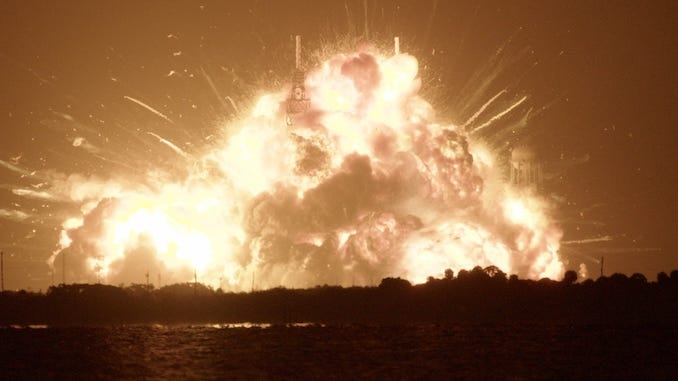
The rocket was being prepared for the NG-4 mission, which was set to be the first launch of Amazon Leo internet satellites on New Glenn, potentially as early as next week. Instead, the explosion will set back Blue Origin by months as they complete the failure investigation, build and prepare another New Glenn launch vehicle, and repair the destroyed launch site.
For some perspective, the explosion isn’t close to the worst ever. That title would likely go to the 1960 Nedelin catastrophe, where a Soviet R-16 intercontinental ballistic missile accidentally detonated, killing 78 people. It isn’t the largest rocket explosion ever, which would be when a Soviet N1-L3 rocket exploded just two weeks before its competitor, the American Saturn V, successfully landed humans on the Moon.
Fortunately, Blue Origin will almost certainly be fine. Its New Shepard program has been quite successful, and with the backing of Jeff Bezos, Amazon, and NASA and the competitive pressures of the space industry, it’s only a matter of time before New Glenn returns as well.
And more…
OpenAI launches Rosalind Biodefense2. Readers of Vitalik Buterin might recall d/acc, the philosophy of building societal resilience against the risks of technology, like pandemics, in order to allow the technology itself to proliferate with less fear. Rosalind Biodefense is a new initiative where “trusted developers” can use OpenAI models, including GPT-Rosalind, a frontier model with better bio knowledge, in areas like epidemiological modeling, early detection, screening, and other public health capabilities. One of the scariest potential applications of AI is designing a pandemic virus, so it’s great to see labs working on preparedness and mitigation.
Tokenmaxxing is coming to an end. After months of businesses encouraging employees to spend as much as possible on AI (contributing to astronomical growth in annualized revenue for AI companies), many have run out of allocated budget for the year just a few months in and are encouraging employees to spend more wisely. Google said it now processes over 3.2 quadrillion tokens a month, which is just an insane number — a million billion, or a thousand million million. When was the last time you saw anything measured in quadrillions?
Samsung is shipping the first HBM4E. HBM4E is the seventh generation standard of HBM (high-bandwidth memory), the integral component of semiconductors that has sent markets into the stratosphere over the last few months. Today, Samsung shipped the first engineering samples of HBM4E to key customers (likely including Nvidia). Samsung (and competitors Micron and SK Hynix) are targeting 2027 for mass production of HBM, in time for mass production of Nvidia’s Vera Rubin chips.
Banger Review


Named after John Glenn, who has an incredibly “mid-20th century Great American” life story. He was born in 1921, the son of a WWI veteran plumber and a teacher, and grew up in the tiny town of New Concord, Ohio. He was a varsity football player in both high school and college, where he majored in chemistry. He dropped out to enlist in the Army Air Corps in WWII. He became a distinguished fighter pilot, flying 149 combat missions in the Pacific Theater, the Chinese Civil War, and the Korean War (where he flew alongside legendary baseball player Ted Williams). He then became a Navy test pilot. In 1957, he made the first supersonic transcontinental flight, taking the first panoramic photo of the US on the way. He became one of the first people to join NASA, and in 1962, became the first American in orbit when he flew the Mercury-Atlas 6 mission, making him a national hero. Soon after, he retired from NASA and the Navy (where he was a colonel) and went into business and politics. In 1974, he was elected to the United States Senate as a Senator from Ohio, where he served for 24 years. In 1998, Glenn returned to space on the STS-95 Space Shuttle mission at age 77, becoming the oldest person ever to reach orbit. He died in 2016 at the age of 95 and was buried in Arlington National Cemetery.
Named after Rosalind Franklin (1920-1958), an English chemist who was integral in the discovery of the double-helix structure of DNA along with James Watson, Francis Crick, and Maurice Wilkins.