
5/20: AI solves an unsolved math problem (for real this time)
Plus: OpenAI is preparing to IPO, Anthropic is profitable, the White House is working on an EO, and Minnesota makes prediction markets illegal

It’s Wednesday, monitors, and we have much to discuss. Catch us on X and YouTube and be sure to join our Discord to chat with our hosts live.
Today’s Experts
Taylor Lorenz (User Mag): 10 AM PT / 1 PM ET
Alexander Doria (Pleias): 10:30 AM PT / 1:30 PM ET
Nathan Leamer (Fixed Gear Strategies): 10:45 AM PT / 1:45 PM ET
Will Bryk (Exa): 11:15 AM PT / 2:15 AM ET
Deedy Das (Menlo Ventures): 11:30 AM PT / 2:30 PM ET
Aghi Marietti (Kong): 12 PM PT / 3 PM ET
Michael Blau & Justin Blau (Dripstack): 12:30 PM PT / 3:30 PM ET
Mika Senghaas (Prime Intellect): 12:45 PM PT / 3:45 PM ET
Immad Akhund (Mercury): 1:30 PM PT / 4:30 PM ET
Nikunj Bajaj (TrueFoundry): 2:30 PM PT / 5:30 PM ET
Chris Gayomali (SSENSE): 3:15 PM PT / 6:15 PM ET
Making Sense of the World
OpenAI solves a real math problem
In 1946, renowned mathematician Paul Erdős defined a simple problem: if you place n points in a plane, what is the maximum possible number of pairs of points that can be exactly 1 unit of distance apart? This problem, the planar unit distance problem, became one of the most well-known in the field of combinatorial geometry. Erdős conjectured that the “square lattice” solution shown below was more or less optimal.
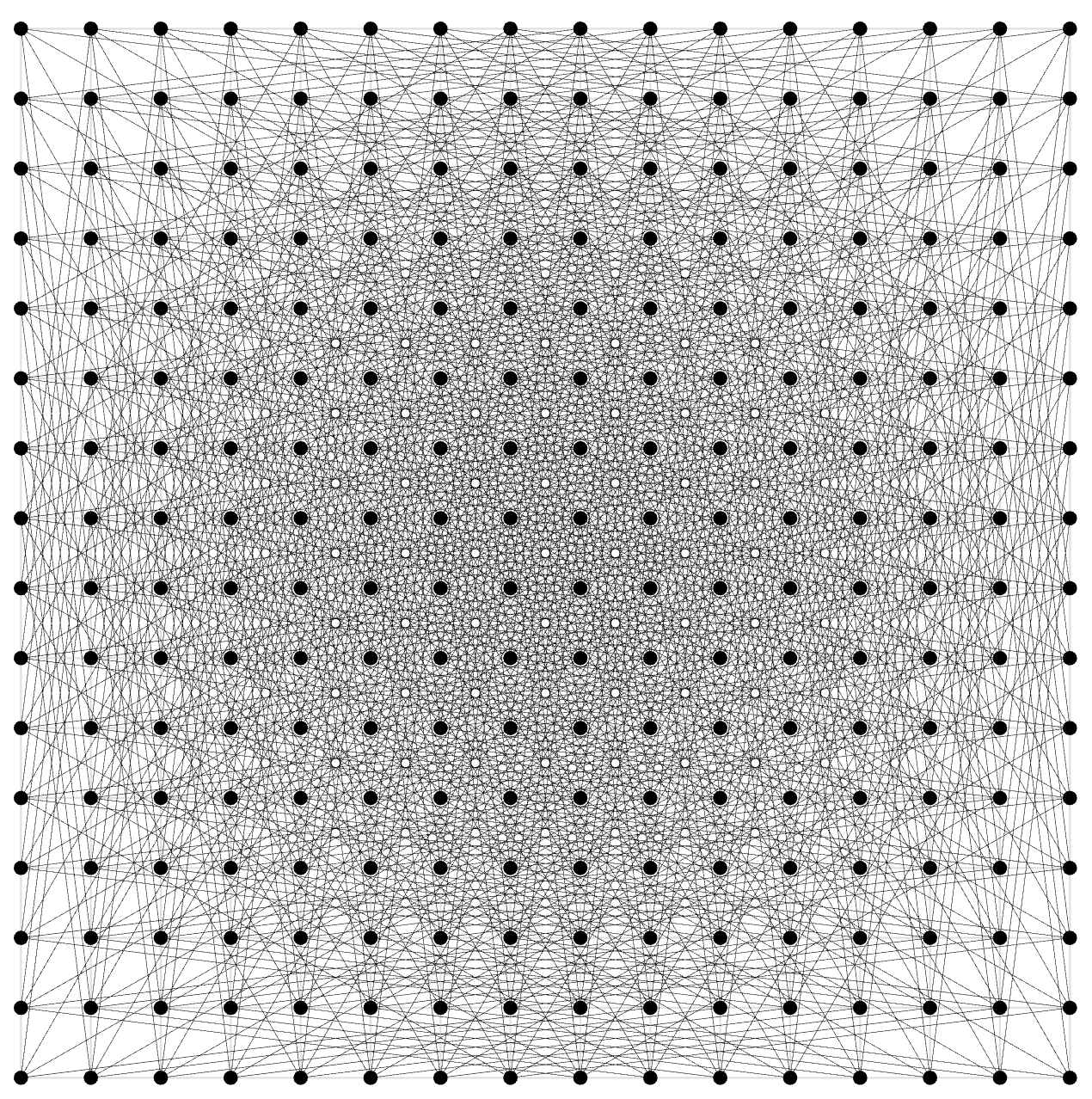
An internal OpenAI model just disproved this conjecture, finding a more optimal solution. This is a big deal. This isn’t a literature review that found a previously unpublished human solution, or a slight improvement to an existing human solution, or a solution to some minor subproblem that no one cares about. It’s a fully AI-discovered novel solution to a well-known open problem central to a field of mathematics.
Just as crucially, the result came from a general-purpose reasoning model, not a model specifically designed for math like Google’s AlphaProof. It’s possible that this model is the next version of GPT-5.5 Pro, soon to be released to millions of ChatGPT subscribers worldwide. The dream of a genius in everyone’s pocket is one step closer to becoming a reality.
And more…
OpenAI is preparing to IPO. The company has been working with Goldman Sachs and Morgan Stanley on a draft IPO prospectus to be filed with regulators soon, with a goal of going public as soon as September. Polymarket projects an IPO closing market cap in the $1.5T range, which would make it the second-largest IPO of all time after Saudi Aramco.
Anthropic is profitable. The company generated $4.8B in revenue in Q1. In Q2, it projects to make $10.9B in revenue and $559M in operating profit, reaching breakeven two years before it was expected to. Compute and infrastructure costs as a percentage of revenue are decreasing, suggesting increased efficiency. One of the most incredible runs in the history of capitalism.
The White House will release their AI executive order soon. The Office of the National Cyber Director held a briefing for AI labs on the long-awaited EO, which would establish a voluntary framework for labs to share frontier models with the government up to 90 days before public release. This represents a sizable shift on the Trump administration’s laissez-faire AI policy, and could eventually lead to labs entering a closer government orbit.
Nvidia is making tons of deals. The company spent about $47B on investments and partnerships from January 2025 to January 2026, and another $43B since then, plus another $95B on component supply and manufacturing capacity, plus another $80B on share repurchases. Nvidia’s biggest partnerships include Groq, CoreWeave, IREN, Lumentum, Coherent, Marvell, and Corning.
Nvidia also reported earnings today: $81.6B in sales, up 85% year-over-year, $58.3B in net income, up over 3x year-over-year, beating analyst estimates on both. The company’s stock fell 0.66% after hours.
Minnesota bans prediction markets. Under a new law signed by Governor Tim Walz, it is now a felony to create, operate, or advertise a prediction market, with violators facing up to five years in prison. Minnesota is the first state to pass such a law. The CFTC sued to block the law’s passage.
Intuit and Meta are doing huge layoffs. Intuit is laying off about 3,000 employees, or 17% of its global workforce. Meta laid off about 8,000 employees (10% of its workforce) and reassigned another 7,000 to new AI initiatives, which are facing internal pushback — over 1,500 employees have signed a petition opposing Meta’s plan to track employee computer-use data for model training.
China is aiming for chip self-sufficiency. The Chinese government has banned imports of the NVIDIA RTX 5090D v2, a nerfed version of Nvidia’s flagship RTX 5090 gaming chip designed to comply with US export controls. This comes, surprisingly, as the US government signals openness to allow more chip exports to China. Alibaba today unveiled a new AI chip, the Zhenwu M890. The chip is a major improvement over Alibaba’s previous generation, but still far behind top US chips like Nvidia’s B200.
Today’s Drop
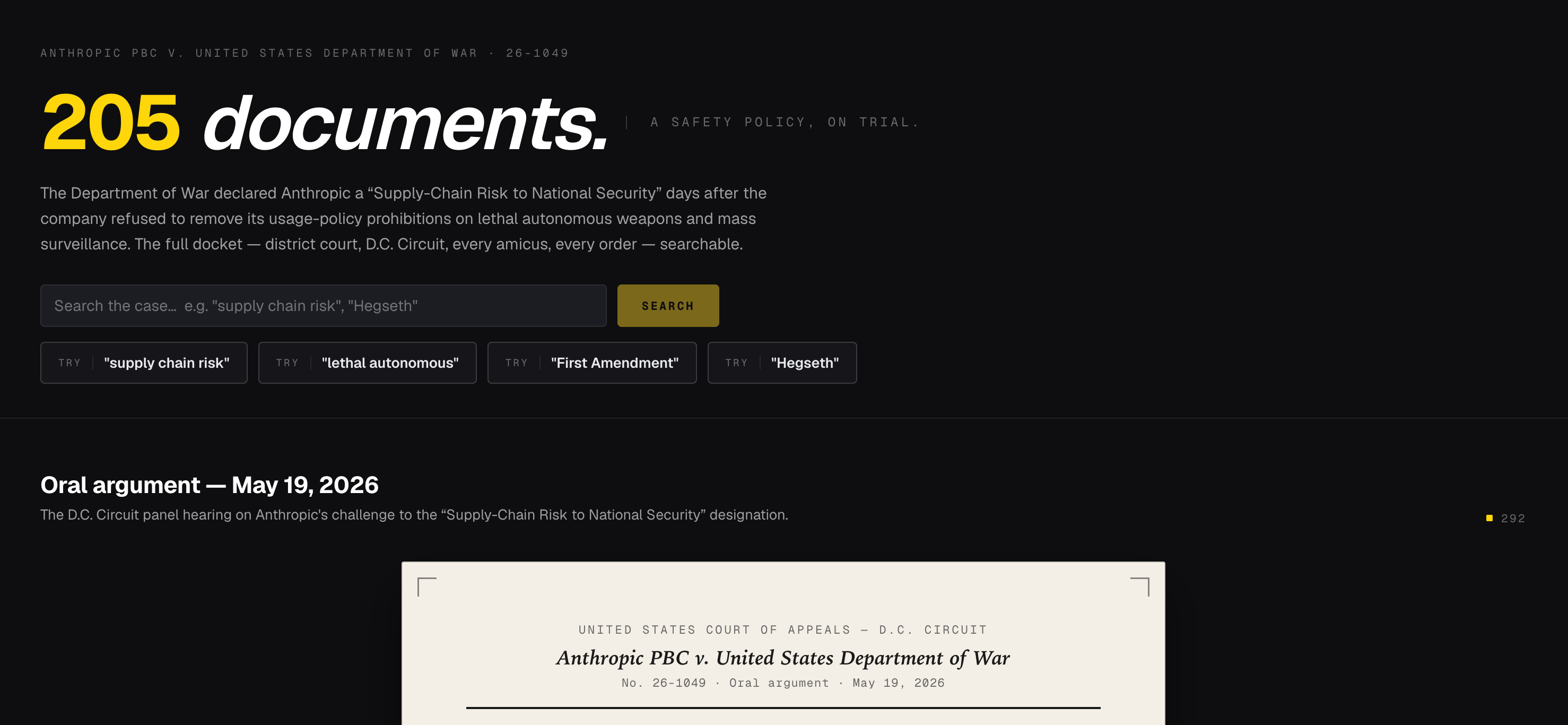
Yesterday, the United States Court of Appeals for the D.C. Circuit heard oral arguments in the case of Anthropic PBC v. United States Department of War, part of the ongoing legal battle between Anthropic and the Pentagon on the company’s status as a supply chain risk. We published over 200 documents, from argument transcripts to amicus briefs to court orders to evidence, at evidence.mts.now.
Banger Review


